
The Reality of Retrofit. It’s a Direction of Travel.
There’s a version of retrofit that exists almost entirely on paper. It’s neat, sequential, fully funded. Fabric first, services second, heat pump at the end. A single project, delivered in one go, signed off and complete. That version exists, but for most people, it isn’t happening.
Three streets from my house, a different version is playing out.
I spend most of my time travelling the country filming other people’s retrofit projects, but this one is close enough to walk to. However it won't look like one of those TV oven baked show pieces. It's a house that has been changing, slowly, over time. Solar went on when the scaffolding was up. Insulation was added when it could be afforded. Storage followed. And now, heating.
“I don’t have enough money to do it all at once. That is the straight answer.” - Tom
That sentence is the reality of retrofit in this financial climate.
This is not a failed retrofit. It is not incomplete. It is simply in progress. A series of rational decisions, taken when the conditions allow. Save, act, wait, repeat. Not driven by a masterplan, but by intent. Make the house cheaper to run, more efficient, more self-sufficient, and less exposed to whatever the energy system decides to do next.
“Save up for a period of time, do one improvement… and gradually, we will make all the improvements that we want over a long period of time.” - Tom
That model, piecemeal, incremental, opportunistic - is not a compromise. It is, increasingly, the dominant pathway.
The conditions are shifting underneath it. Finance is beginning to open up through organisations like Lendology. There are changes coming to how solar may be funded in the UK. Energy prices remain volatile, geopolitics remains unstable, and the idea of long-term certainty in household energy has quietly disappeared. In that environment, waiting to do everything at once becomes less rational than doing something now.
What Tom is doing, and he is far from alone, is building capability in stages. A 3.2kW solar array that carries the house through the summer. A small battery that stretches that generation into the night. Loft insulation increased. Cavity walls filled. Rainwater stored. Each move modest in isolation, but cumulative in effect. Each one reducing demand, cost, and exposure.
The latest step is not a replacement of the heating system, but a preparation for what comes next.
Instead of ripping out floors for underfloor heating, an expensive, disruptive intervention that would have meant rebuilding the kitchen. The decision has been made to increase emitter capacity using skirting board radiators. More surface area. More heat transfer. Less disruption.
“They’ve added about 60% additional heat transfer from the heating loop compared to the radiators on their own.” - Tom
That single change shifts the operating conditions of the entire system. The boiler, previously running at higher temperatures, can now operate at 40°C, the same flow temperature required by a heat pump.
“Now that I can run the heating loop at 40 degrees, in theory I could swap the boiler out for a heat pump… which is my end goal.” - Tom
This is where the narrative around retrofit often breaks down. The conversation tends to jump straight to the end state, install the heat pump, electrify the home, complete the transition. But what’s happening here is something more grounded. The system is being made ready. In real, manageable time slots.
Constraint is doing the design work.
“To dig up the entire concrete floor… we’d have to redo the entire kitchen… and that would be really expensive.” - Tom
So the solution is not the idealised version. It is the viable one. Lower cost, lower disruption, but strategically aligned with the long-term goal. It keeps the pathway open. It avoids dead ends.
Tom is not a hypothetical homeowner. He’s a scout leader in the same unit as me, someone who spends his time helping run a community energy initiative, harnessing solar generation from local rooftops. He understands the systems, the technologies, the trade-offs. And even with that knowledge, this is the route he’s taken.
Not because it’s perfect. Because it works.
What matters here is not the individual measures, but the pattern. This is how retrofit is actually being adopted, not as a single intervention, but as a sequence. Not driven by policy frameworks or ideal models, but by cash flow, timing, opportunity, and lived reality.
And that pattern is about to scale.
As finance improves, as products become more accessible, as energy instability continues to shape decision-making, more households will follow this path. Hundreds of thousands, eventually millions, moving in increments. Solar before storage, emitters before heat pumps, insulation wherever it can be added. Not in order. Not cleanly. But forward.
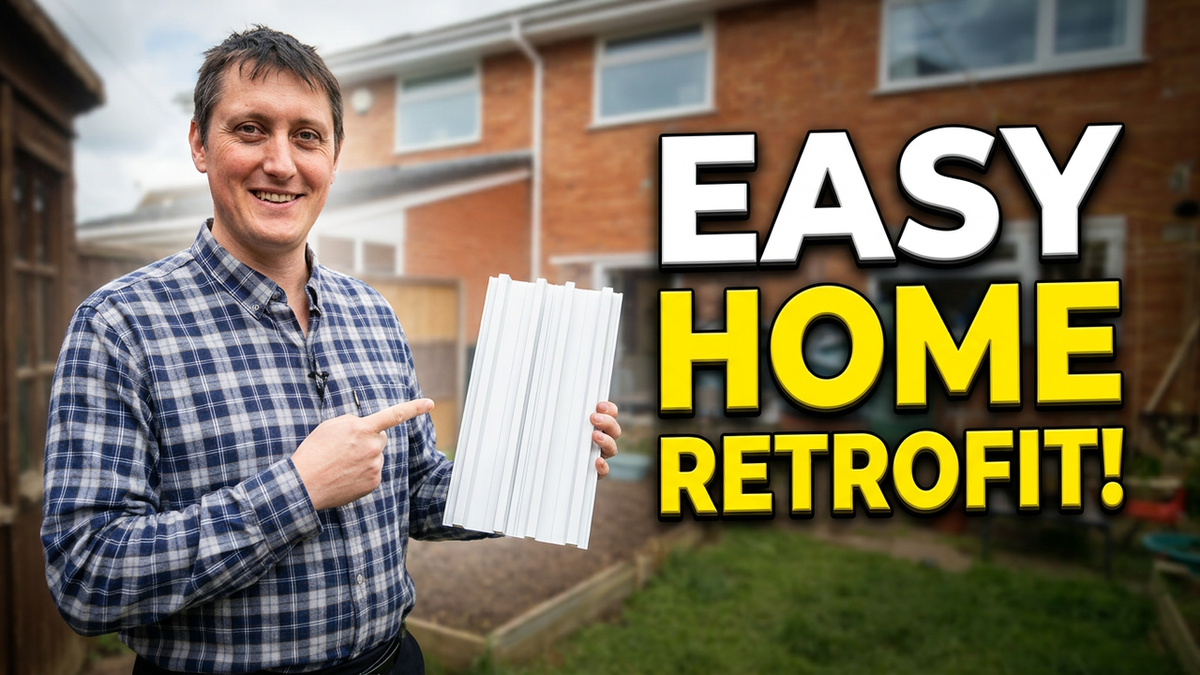
This film features Thermaskirt from DiscreteHeat, a product that appears in many UK homes through platforms like Add2Rad. It’s one example of how these incremental upgrades are being delivered in practice.
As always, this is editorial. No payment, no placement, no influence. We don’t do paid editorial in this magazine.
What we do is document what’s happening.
And what’s happening is this.
Retrofit is no longer a project.
It’s a process.