
When Retrofit Becomes the Benchmark
Step through the front door and the first thing you notice is not a piece of kit.
It is the air.
Outside, Bathgate is doing what Bathgate does in winter. Wind pushing in from the west. A sharpness that gets into your coat. Then the door closes and everything changes. The house is calm. Even. Still. Not stuffy. Not dry. Just… held.
Glorious feels like an overstatement until you stand there for five minutes. Then it does not.
Practically tropical. Definitely time to get the coats off before we started sweating.
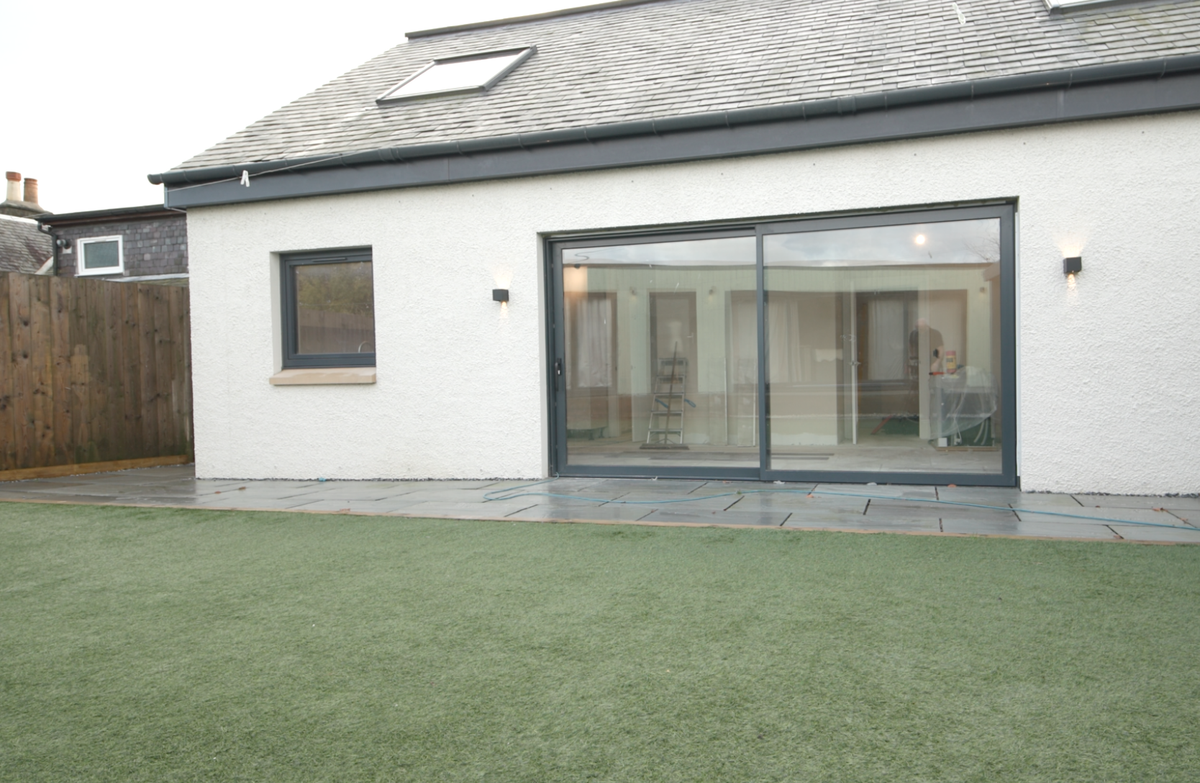
This is a new build in Central Scotland. A self-build, carefully designed and delivered by Gavin for his family. But what makes it remarkable is not the architecture. It is the process behind the heating system. And that process comes straight out of the retrofit playbook.
We are seeing this more and more.
Retrofit standards. New build ambition.
And the two disciplines merging.
A builder who refused to be oversold
Gavin did what any diligent self-builder would do. He asked around. He sought advice. He invited installers in to look at the plans.
What came back was familiar.
Oversized systems. Over-engineered solutions. Over-complicated layouts. And price tags that spiralled accordingly.
The assumption seemed to be that more kit meant more certainty. Bigger meant safer. Complexity meant professionalism.
But as anyone working in retrofit knows, complexity is often a proxy for uncertainty. And oversizing is a hedge against poor design.
So Gavin called in Sean Hogan of Aventus Eco.
This is our second story in a series following Sean’s work across Central Scotland. And once again, the pattern repeats.
Sean walked the site. He ran the numbers. He listened.
Very quickly it became clear that the job was not as expensive as first quoted. Not as complex. Not as difficult to install.
It just needed to be designed properly.
Electrified. Simplified. Right-sized.
There is no gas in this house.
Not a metre of pipe with the old fossil fuel anywhere.
It is fully electrified. But that does not mean it is gadget-heavy. Quite the opposite. Walking room to room, you see the absence of traditional heating clutter. No oversized radiators fighting the fabric. No boiler cupboard dominating the plan. No compromise decisions hidden behind plasterboard.
Every room has a simple, appropriate heating solution. Right-sized for the heat loss. Integrated into a heavily insulated, superbly built structure. The second-fix elements complement the fabric rather than compensate for it.
This is what happens when the starting point is heat loss calculation, not product catalogue.
It is also what happens when a retrofit mindset is applied to a new build.
Retrofit engineers have learned the hard way. They have walked into cold homes with oversized heat pumps short-cycling. They have seen systems designed on assumptions rather than evidence. They have corrected mistakes.
That is the difference between people who get blank canvasses, and those who have to join the dots.
And in this case, it has created a beautiful picture of a family home in Bathgate.
The shift in new build
There is a bigger story here.
For years, retrofit has been seen as the corrective arm of the industry. The one that fixes what new build got wrong. The one that deals with legacy decisions. The one that makes do.
But now, increasingly, new build is borrowing from retrofit.
Detailed heat loss calculations. Fabric-first thinking. Right-sized heat pumps.
Electrification without drama.
The irony is hard to miss. The standards being pioneered in existing homes are now influencing how the best new homes are built.
Sean tells us that this project is part of a wider trend. Builders are starting to realise that the cheapest mistake is the one you do not make. Oversizing a system is not insurance. It is inefficiency baked in from day one.
When you design precisely, you buy less equipment. You reduce complexity. You simplify installation. You lower lifetime costs. And you create comfort that is felt rather than forced.
The result is not flashy.
It is consistent.
Even.
Calm.
Awards and a direction of travel
Sean has started winning awards for this approach. That is notable, but it is not the point.
The point is that the direction of travel is changing.
New build, at its best, is now adopting retrofit discipline.
And retrofit businesses are no longer confined to fixing the past. They are shaping the future.
Standing in this Bathgate home, feeling the difference between the roaring Scottish wind outside and the controlled environment within, it is hard not to think that this should simply be normal.
Not exemplary.
Not award-winning.
Just standard.
If this is the start of new build learning from retrofit rather than ignoring it, then perhaps the industry has turned a corner.
And perhaps the next generation of homes will not need fixing in the first place.