
The Warm Homes Plan
Solar got a boost, batteries are in, but who got left out? And what is the Warm Homes Agency?
Who got the prizes, who’s still in the running - and what got left out
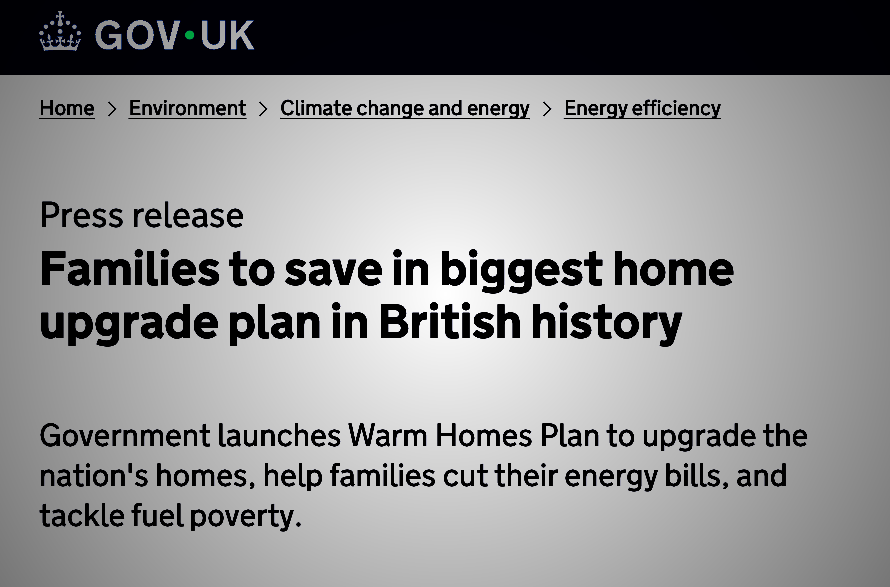
The Warm Homes Plan has been sold as the biggest home upgrade programme in British history. Strip away the slogans and what remains is not a single policy, but a distribution of signals, priorities and favours.
Some actors walked away with clear wins. Some were quietly told to wait.
And some of the most important parts of the retrofit system didn’t get invited at all.
Here’s what the announcement actually did.
The winners
1. Solar PV (finally)
Solar is one of the clearest winners of the Warm Homes Plan. For the first time, on-site generation is named as a central plank of a national retrofit strategy, not a side quest or optional add-on.
This matters because it reframes retrofit logic. Lower bills are no longer expected to come only from insulation and heat efficiency, but from households becoming partial energy producers.
For an industry that has long sat awkwardly between MCS rules, council pilots and private finance, solar’s inclusion is a genuine step up the policy ladder.
2. Battery storage (the quiet promotion)
If solar won loudly, batteries won quietly.
Battery storage is explicitly referenced as part of the bill-reduction toolkit, which is new at national policy level. Until now, batteries have lived in pilot schemes, innovation funds or as a consumer upsell for the well-informed.
This is the first time government has tacitly accepted that:
- time-of-use tariffs matter
- grid constraints matter
- flexibility matters inside the home
It’s a small paragraph with big implications.
3. Local authorities (again)
Councils remain at the heart of delivery. Despite repeated frustrations with stop-start funding and capacity strain, local government is once again trusted with the keys.
From Whitehall’s perspective this is pragmatic. Councils already hold data, relationships and delivery partners. From the sector’s perspective, it is a double-edged win: responsibility without long-term certainty remains a risk.
Still, in political terms, councils kept their seat at the table.
Still in the running
4. Heat pumps
Heat pumps neither won nor lost. They stayed exactly where they were.
The £7,500 grant remains unchanged. No redesign, no escalation, no simplification. The Boiler Upgrade Scheme is simply absorbed into the Warm Homes Plan narrative.
Heat pumps remain essential to decarbonisation, but they did not receive a new push. Instead, they are now framed as one component in a broader system that includes fabric, solar and storage.
That’s not a demotion - but it’s no longer a coronation.
5. Insulation and fabric
Fabric-first remains the foundation, but not the headline. Insulation is treated as assumed knowledge rather than political excitement.
This reflects reality. Fabric works. It always has. But it is also slow, disruptive and hard to message at scale.
Insulation is still in the race. It’s just no longer the star of the press release.
The prize that is also a problem
6. The Warm Homes Agency
On paper, the Warm Homes Agency looks like a win. A new body to coordinate fragmented programmes, standardise delivery and impose some order on a chaotic system.
In reality, it’s a prize with strings attached.
The Agency exists because government recognises that the current system cannot scale. That recognition is overdue and welcome. But the Agency is not independent, not a new funding bank and not a delivery body. It sits inside DESNZ, coordinating programmes that already exist.
This creates a risk.
If the Agency becomes a manager of complexity, rather than a remover of it, the sector gains another layer without losing any friction. Oversight alone does not fix performance gaps, labour shortages or poor homeowner experiences.
The Agency could become the solution.
Or it could become the filing cabinet.
The difference will come down to whether it tackles outcomes, not just administration.
What got left out
7. Performance monitoring
The most striking omission from the Warm Homes Plan is measurement.
There is no mandatory requirement to monitor real-world performance after installation. No national commitment to closing the gap between design intent and lived experience.
Without data, the system cannot learn. Without learning, the same mistakes repeat - just under a new banner.
8. EPC reform
EPCs remain the backbone of targeting, eligibility and compliance, yet the Warm Homes Plan says nothing about reforming them.
That silence is quite jarring. Scaling retrofit on a metric the sector itself distrusts is a structural risk, no matter how well coordinated the programmes become.
9. The homeowner journey
Perhaps most importantly, the Plan still does not present retrofit as a single, intelligible journey for households.
Fabric here. Heat there. Solar later. Batteries if you’re lucky.
Until the system offers households a clear, staged pathway - technical, financial and practical - uptake will remain slower than ministers hope.
The verdict
The centre of gravity has shifted. Solar and batteries now sit closer to the heart of the programme, while heat pumps remain a constant rather than a catalyst. Delivery still rests with local authorities, and a new Warm Homes Agency has been created to bring coherence to a system that has long lacked it.
This may stabilise delivery. Transformation will require more than reorganisation.
The real prizes will be awarded not by a press release, but by performance - measured in homes that are warmer, cheaper to run, and trusted by the people living in them.