
Some Things Are Changing for Boys. What About Girls?
Whilst some boundaries are moving, some barriers still exist. It's not gender wars, it's maths.

Some things are changing for boys.
At his first rugby training session this week, my son arrived carrying his boots and rugby ball, his fingernails painted silver and gold.
And that was that.
He played rugby. No jabs, ribbing or jokes.
It is a tiny thing, perhaps, but also a rather encouraging one. Some of the boundaries we once drew very firmly around what boys and girls were supposed to look like, enjoy and become are beginning to blur.
But in the industries that will actually build the UK's future, some of those boundaries are proving remarkably stubborn.
Where are the women in retrofit?
Anyone who spends much time around retrofit, heating, construction or building services will recognise the problem.
Look around an installer event, a technical training room or many of the businesses physically delivering retrofit and women remain conspicuously underrepresented.
That is problematic - far beyond appearances.
The UK is attempting to decarbonise millions of homes while simultaneously dealing with shortages of people capable of surveying, designing, specifying and installing the technologies needed to do it.
We cannot complain about a skills shortage while effectively drawing from only part of the available population.
New analysis commissioned by precision engineering component supplier Accu provides a useful reminder of just how far there is still to go.
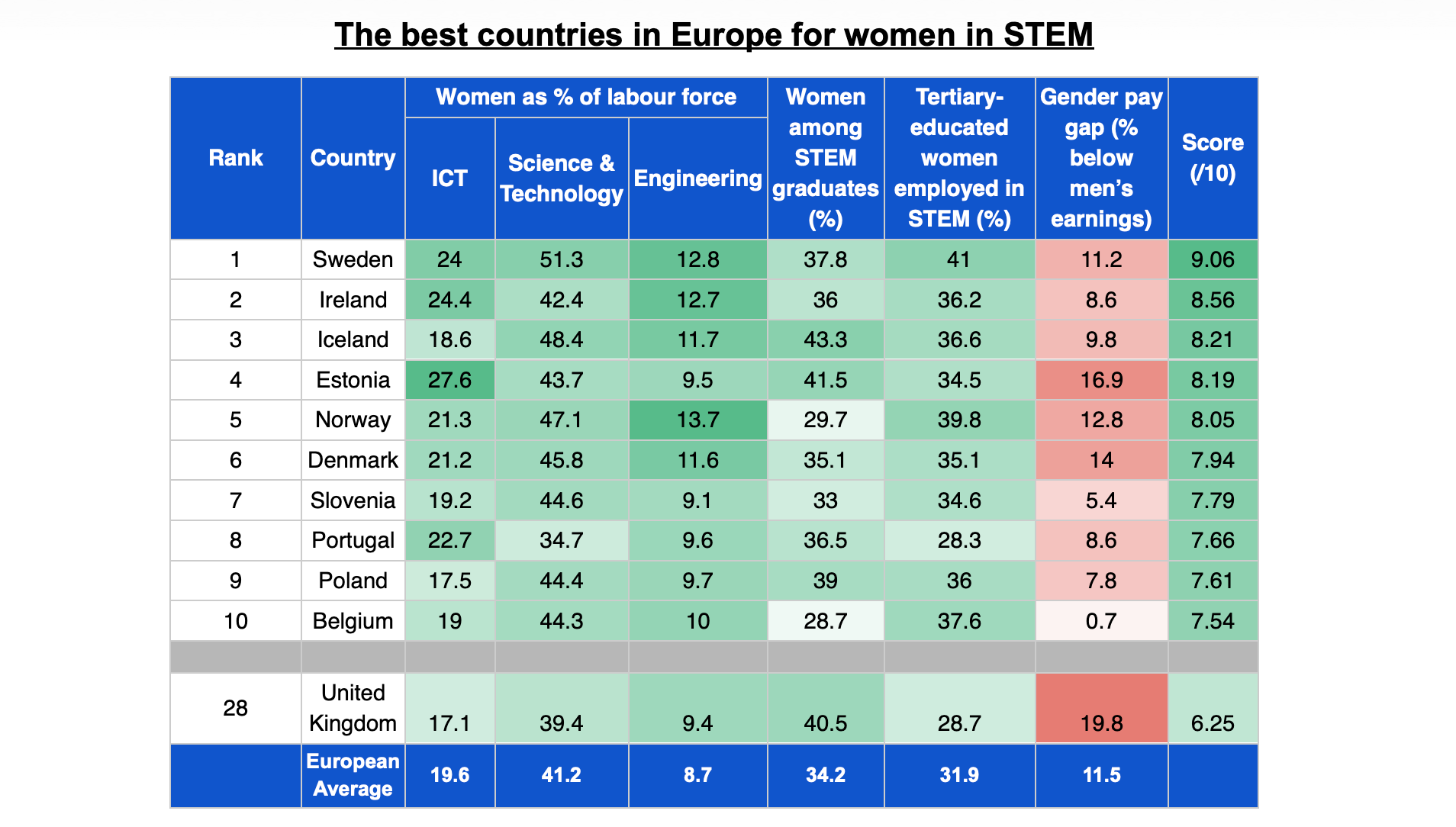
Its European comparison places the UK 28th for supporting women in STEM, with an overall score of 6.25 out of 10.
According to Accu's analysis, women account for just 17.1% of UK ICT specialists and 9.4% of engineers. Women make up 40.5% of STEM graduates - relatively close to the 41.2% European average - yet only 28.7% of tertiary-educated women are employed in STEM, against a European average of 31.9%.
That suggests the problem isn't simply persuading girls to study technical subjects.
It is what happens afterwards.
Opening the door isn't enough
Accu's Lead Engineer Patrick Faulkner warns that decisions made while children are still at school can have consequences much further down the line.

“For girls, there’s additional risk. Research shows that girls aged 14 experience their lowest levels of confidence, which is around the same time that they begin to think about their career paths, choosing their GCSEs accordingly.”
Faulkner was responding to proposals from Andy Burnham to align education more closely with the requirements of local labour markets.
There is an obvious attraction to connecting education with real employment opportunities. But Faulkner argues that it must not inadvertently narrow children's horizons:
“Young people risk getting limited exposure to a variety of sectors, and might feel pushed in one direction.”
For retrofit, this is particularly pertinent.
The sector needs heat-pump engineers, electricians, building physicists, architects, retrofit coordinators, energy assessors, designers, manufacturers, data specialists and researchers. It also needs the next generation of people who haven't yet heard of half of those jobs.
If girls don't see those possibilities early enough, the retrofit industry cannot simply expect them to appear at its doors ten years later.
This is a workforce problem
Accu's analysis also highlights something uncomfortable about progression once women enter STEM.
Its modelling puts the UK's gender pay gap at 19.8%, compared with a European average of 11.5%. By contrast, Sweden tops Accu's overall ranking for women in STEM with 9.06 out of 10, followed by Ireland at 8.56.
Faulkner argues that whatever shape future education policy takes, young people need room to discover where their interests and abilities might lead them.
“The country needs to at least grant girls the freedom to learn about and explore the industry without any political or regional barriers.”
For retrofit, perhaps we should go further.
This isn't simply an equality issue sitting somewhere alongside the industry's more pressing concerns about skills, recruitment and capacity.
It is part of the same problem.
We need thousands of people to transform Britain's buildings over the coming decades. If girls can study STEM but don't subsequently enter technical careers - or enter them and find fewer opportunities to progress - we are wasting talent that the sector badly needs.
My photograph from that first rugby session gives me a little optimism.
A boy can turn up to play rugby with silver-and-gold fingernails and discover that one old boundary doesn't matter quite as much as it once did.
Perhaps the challenge for retrofit is to make just as unremarkable a sight of a woman arriving on site with a heat pump, a set of gauges, a laptop or a tool bag.
We aren't there yet.
We are still fiercely independent and this editorial was not paid for, but we acknowledge the assistance provided by Accu and the provision of statistical analysis for us to proof read. Accu tools and components are already used on engineering sites across the UK, and their contribution to active debates like this one is welcome.
Please see this breakdown of the Methodology used in the Accu analysis;
Methodology:
- Accu sought to identify the best European countries for women in STEM.
- Country-level data was collected for European countries from Eurostat, covering the following metrics:
- Workforce participation in STEM
- Share of women among ICT (Information and Communications Technology) specialists
- Share of women employed in science and technology (as a proportion of the labour force)
- Share of women working as scientists and engineers (as a proportion of the labour force)
- Share of tertiary-educated women employed in science and technology (as a proportion of the labour force)
- Education pipeline
- Share of women among tertiary STEM graduates
- Female tertiary STEM enrolment per 1,000 people aged 20–29
- Economic outcomes
- Gender pay gap, expressed as how much less women earn compared with men on average
- These indicators together reflect both access to STEM education, representation in STEM employment, and quality of outcomes for women.
- Because all datasets included historical time series, missing values for 2025 were estimated using the Prophet time-series forecasting model. Forecasts were generated separately for each country and metric, using historical trends.
- The 2025 values were used consistently across all indicators to calculate final scores.
- A regional median was calculated. Each country’s performance was then compared with this median to show whether it performs above or below the European norm.
- The data was collected in February 2026 and is accurate as of then.