
Renovation Is Britain’s Biggest Retrofit Inflection Point.
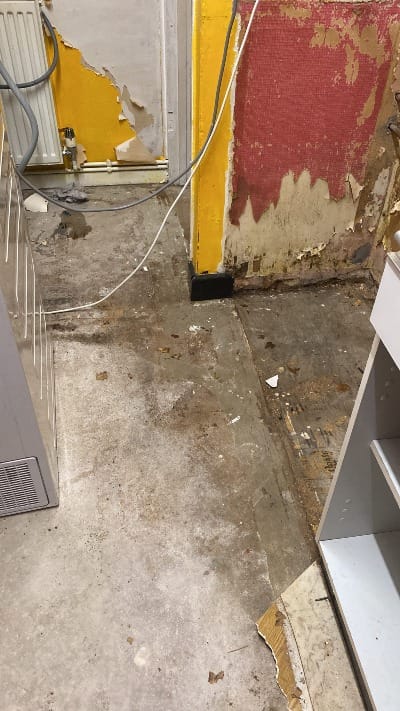
So Why Are Homes Often Made Worse?
Most people in the UK do not want the disruption of a whole-house retrofit.
That single fact explains the growing popularity of low-disruption retrofit products such as Heat Geek’s Zero Disrupt approach or DiscreteHeat’s Add2Rad system. These solutions succeed because they meet the strongest and least discussed homeowner demand in retrofit: the desire to stay put.
But the real story is not the products.
It is the moment they rely on.
Because the inflection point these systems operate within is not day-to-day living.
It is renovation.
And that is the gap more retrofit companies, policymakers and designers should be targeting.
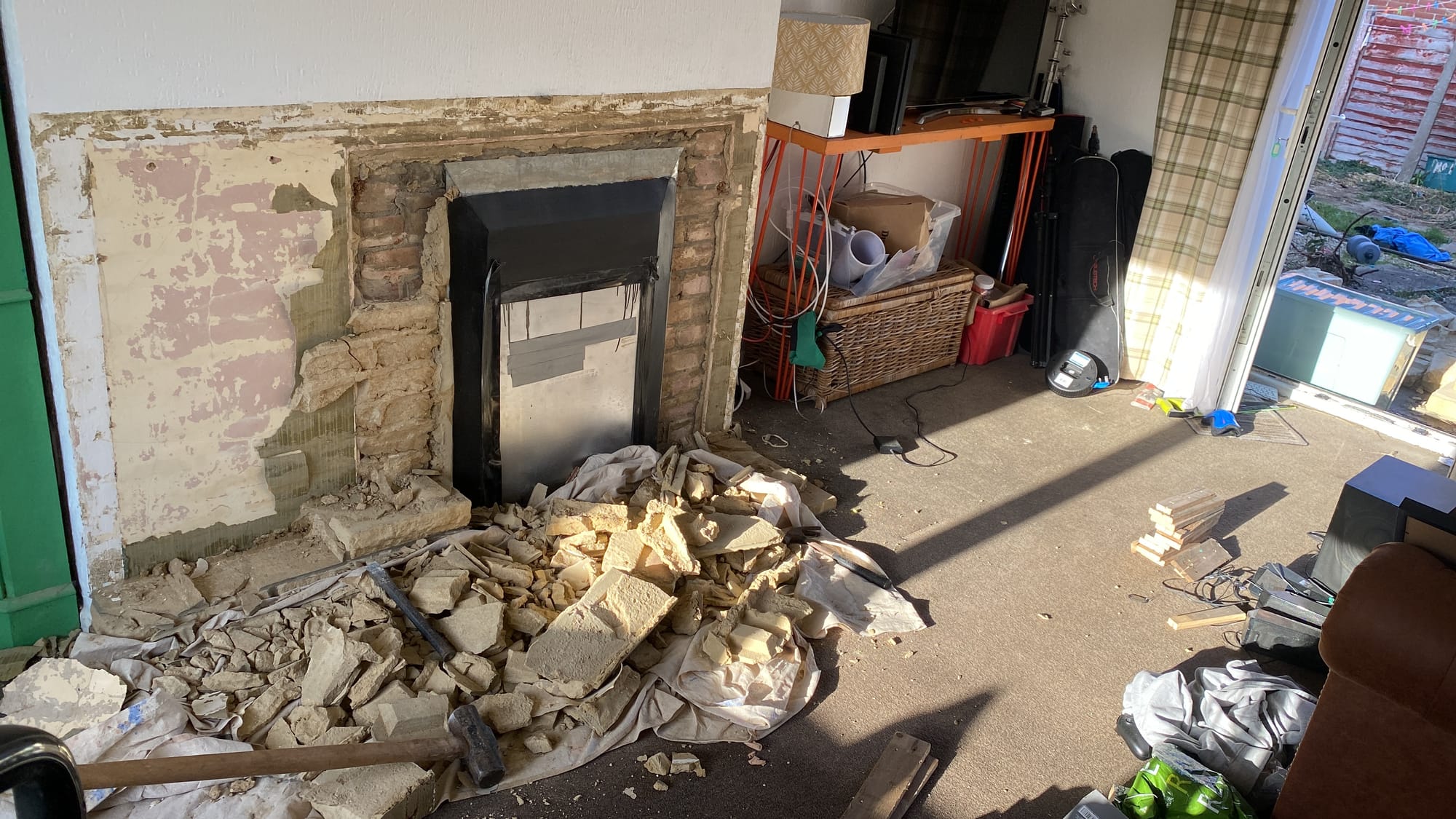
The truths we already know
Most meaningful upgrades in UK homes already happen during renovation or extension works. That is why the Office for National Statistics tracks Repair, Maintenance and Improvement activity as a distinct and economically significant part of the construction sector. RMI is where money is spent, disruption is accepted, and trades are already on site.
In households, renovation is traditionally framed as an aesthetic or spatial capital spend. Kitchens, bathrooms, extensions, finishes. Comfort is the objective but performance is not interrogated.
And yet one persistent assumption underpins policy, marketing and media narratives.
That homeowners experience renovation and retrofit as separate decisions.
These three facts are interlinked. Renovation is already the moment when walls are opened, services are touched, layouts change and budgets are committed. It is also the moment when energy performance improvements could be integrated with minimal additional disruption.
Instead, energy outcomes are often left to chance.
The renovation paradox
And this actually happens.
Many homes in the UK emerge from renovation with a worse EPC rating than before.
Sometimes that is because floor area has increased. Sometimes because glazing has been added without improving fabric elsewhere. Sometimes because heating systems have been replaced like for like, locking in high temperature operation for decades. Sometimes because airtightness and ventilation were never considered as part of the sequencing.
And sometimes it is because the EPC itself is a blunt instrument.
But the outcome is the same. Significant capital is spent. Disruption is endured. And the opportunity to meaningfully improve how the home performs is either diluted or lost entirely.
This is not a marginal issue. It is systemic.
More than half of UK homes still sit at EPC D or below. The route to improving that stock does not run primarily through standalone retrofit projects. It runs through the renovation decisions people are already making.
Why renovation makes or breaks retrofit
Retrofit fails when it is introduced too late.
By the time a homeowner is considering a heat pump, the radiators have often been replaced. By the time ventilation is discussed, kitchens and bathrooms are already installed. By the time insulation is raised, finishes are complete and budgets are exhausted.
Renovation sets the direction of travel, whether consciously or not.
Extensions that are built to minimum compliance, while the original house remains thermally poor, create permanently unbalanced homes. New kitchens that ignore ventilation strategy increase moisture risk. Boiler swaps carried out during renovation lock in system design that resists future electrification.
None of this happens because homeowners do not care.
It happens because the system shows up too late.
Renovation as an inflection point
There is a useful lesson here from outside the built environment.

During the London 2012 Olympics, Barclaycard ran a widely overlooked campaign to promote contactless payments. The technology already existed. Adoption was slow. People were unconvinced it was necessary.
Barclaycard did not try to persuade consumers at home.
Instead, they targeted a moment of mass disruption and altered routine. Temporary venues. Queues. Crowds. Point of sale pressure. Contactless prompts were quietly embedded into the experience.
For many users, the interaction was unremarkable. But it worked.
Those Olympic transactions normalised contactless payments. They tested behaviour at scale. And they paved the way for what is now a default payment method.
Retrofit faces the same challenge.
It does not fail because the technology is immature. It fails because it is introduced at the wrong moment.
Renovation is that moment.
The EPC problem inside renovation
The EPC sits awkwardly at the centre of this paradox.
As a compliance tool, it was never designed to guide complex, staged renovation decisions. It rewards fuel cost assumptions rather than system readiness, comfort, resilience or carbon reduction. It struggles to recognise partial upgrades. It often penalises homes mid-transition.
As a result, renovation outcomes are frequently misrepresented. Homes that are more comfortable and more future-ready can appear worse on paper. Homes that look efficient can remain brittle and expensive to run.
This creates a dangerous feedback loop. Homeowners believe they have improved their home. The EPC suggests otherwise. Trust erodes. Retrofit is framed as confusing, risky or contradictory.
None of this encourages better decisions next time.
Let's talk about renovation + retrofit now
The UK does not have the luxury of missing these moments.
Government analysis repeatedly shows that upgrading homes to EPC C and beyond delivers substantial economic and social benefit. But those gains depend on sequencing, quality and permanence. They cannot be delivered by bolt-on measures applied after renovation decisions are locked in.
The Warm Homes Plan, the evolution of EPC reform, and the increasing focus on whole-house approaches all point in the same direction.
Delivery matters more than ambition.
And delivery starts at the renovation table, not the retrofit sales pitch.
The missed audience
Renovators are not anti-retrofit. They are under-guided.
They are making complex decisions under time pressure, cost pressure and emotional pressure. They are balancing space, aesthetics, family needs and budget. Energy performance rarely arrives framed as an enabler. It arrives framed as a complication.
That is a communications failure as much as a technical one.
If retrofit is positioned as a parallel project, it will always struggle. If it is positioned as a value-protecting layer within renovation, it becomes obvious.
Why the NSBRC matters
This is why renovation shows matter. And there's one on at the end of this week at the national centre.
The National Self Build and Renovation Centre sits at the intersection of aspiration and execution. It attracts people at the exact moment decisions are being made. The growing prominence of retrofit within that space is not accidental.


Renovation Winter Show 30th Jan - 1st February
But visibility alone is not enough.
The question is not whether retrofit is present at renovation events.
It is whether it is integrated early enough to change outcomes.
What needs to change
Retrofit does not need louder marketing. It needs earlier involvement.
Designers, builders, retrofit coordinators and product manufacturers need to align around renovation as the primary delivery channel. Not as an add-on. Not as an upgrade later. As the foundation.
The opportunity is already there. We are just walking past it.
This week on Refurb & Retrofit
This article opens a week examining renovation as Britain’s most under-used retrofit lever.
We'll discuss how one company changed their product positioning in sales outlet, to target renovators, why renovations can lower your EPC, how correct sequencing with heat pump installs can improve your whole house after renovation and why aesthetics don't have to compete with physics.
Renovation is not just about what a home looks like. It is about what it becomes.
And for most UK homes, that decision is being made right now.
This weeks stories about renovations are being sponsored by Halcyan Water. Find out more about their solutions as we release case studies of their fight against hard water and limescale each day for the rest of the week.