
Drones In Construction: What's In It For Retrofit?
British drone developers are focussing on construction. But they are missing one thing.

Anyone with a military background will regale you with the dizzying development of drone capabilities emanating from the war in Ukraine.
They'll probably also have a view on the redundancy of ageing armour, the changing role of humans on the battlefield and the potential for machines to take over dangerous and deadly tasks.
But what if just a scintilla - a smidgeon - of that development found its way into construction?
As an indication of how closely the risks of warfare and construction have occasionally been considered, someone actually submitted a Freedom of Information request to the ONS comparing deaths in the Ministry of Defence with deaths in construction between 1980 and 2022.
On the face of it, it's a glib comparison. War is always going to be more deadly.
But construction has another problem.
The occupational health consequences of repetitive, physically demanding work accumulate over decades. Lifting. Carrying. Climbing. Working at height. Kneeling. Reaching. Doing the same difficult physical task hundreds or thousands of times.
The result is that many men and women who entered construction young can reach middle and later life carrying the consequences of the work they did.
It also makes the essential work we need done considerably less attractive to the next generation. So where is our robot help? And what could it feasibly be doing?
We interviewed Dr Mickey Li to find out.
Robots For Us?
Dr Li is Senior Research Fellow in Robotics, AI and LIDAR Software Engineering for Aerospace Applications at UCL. He's part of a team of scientists and engineers developing systems that could ultimately change the way construction work gets done.
Alongside co-lead Dr Vijay Pawar, his work explores the opportunities for drones and robotics to operate in environments that remain overwhelmingly dependent on human labour.
And there is a long way to go.
Dr Li starts with the obvious advantage drones already possess:
"We see an opportunity for drones to help take on jobs in hard to reach places, both inside and outside buildings."
That simple sentence describes an enormous number of tasks in retrofit, repair and improvement.
Everyone from a scaffolder to a solar installer knows the cumulative effects of lifting, loading and carrying materials around buildings, often while simultaneously negotiating ladders, scaffolds, roofs and awkward spaces.
Load-carrying robots are already being developed and deployed for extraordinarily demanding environments.
Construction is rather less dramatic.
But the underlying question is similar: why are we still using human bodies for jobs machines could do?
Dr Li points to lifting technology that already exists:
"Commercial cargo drones, including DJI’s FlyCart range, already offer lifting and winch systems. The opportunity for construction is to fit that capability into a controlled, repeatable site operation that complements concurrent work."
Moving materials safely over short distances could potentially transform parts of an installation.
It doesn't suddenly make scaffolding redundant. People still need safe access to carry out the work.
But could materials be positioned ahead of them? Could repeated journeys carrying equipment up and down buildings disappear?
For the moment, humans remain firmly in the loop.
"For now, you would still need a human to control loading, or at the very least supervise the operation for safety."
Sampling and Testing
Then there is surveying.
We've attended plenty of buildings where the cost of investigating damp, mould, façades or substrates has been inflated considerably by one thing: access.
Sometimes getting somebody safely to the thing that needs inspecting costs more than the inspection itself. Here, precedent already exists.
Dr Li explains:
"Contact inspection is already commercial in industrial settings. Voliro’s drones carry probes for testing structures, while Flyability’s Elios 3 can take ultrasonic steel-thickness measurements in confined spaces. These demonstrate that drones can do useful measurement work while touching a surface."
That's important.
We're no longer talking about flying cameras looking at buildings.
We're talking about machines physically interacting with them.
So I pushed Dr Li on what that might mean for retrofit.
Could a drone, for example, take moisture readings from a façade that currently requires somebody to get up there?
His answer is deliberately cautious:
"We see this as an application to develop with building surveyors and retrofit specialists. Moisture sampling should be presented as a development opportunity."
In other words: potentially. But someone needs to help develop it.

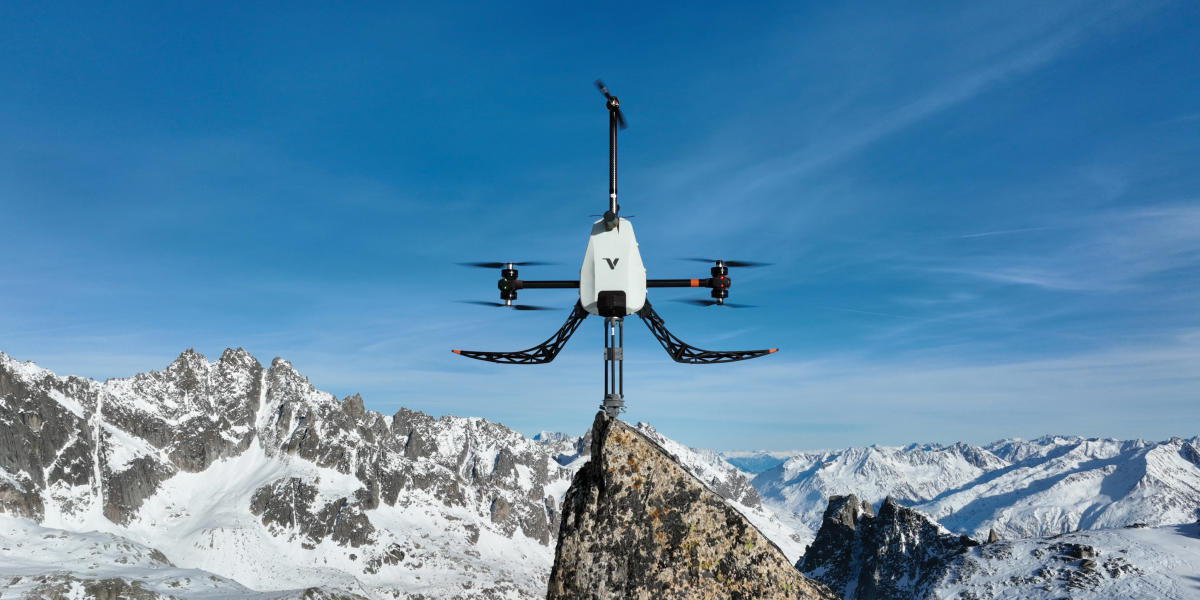
Voliro Take T
Coating and Spraying
The same applies to coatings.
Applying coatings on large retrofit projects, cleaning façades or maintaining equipment at height are exactly the kinds of repetitive, access-heavy operations where keeping humans on the ground starts to make sense.
And development here is already happening.
"Commercial suppliers such as Apellix offer systems for washing and spray coating at height. For refurbishment, these provide examples of drones performing physical work on existing assets."
Which raises an obvious question.
If drones can already lift, inspect, touch, wash and spray things, what exactly are Dr Li and his colleagues trying to develop?
And that gets us to the real problem.
Operational Applications Need Intel
Back to Ukraine for a moment.
Whatever Britain's precise involvement in the conflict - much of which the British military neither confirms nor denies - there is clearly an extraordinary feedback loop between the battlefield and defence development.
People encounter a problem. Engineers hear about the problem. Technology is adapted.
It goes back into the field.
More information comes back. And the cycle repeats.
That operational intelligence is incredibly valuable. Construction needs its own version of it. Because our problems are also becoming strategically important.
An ageing workforce. Falling manpower. Experienced people retiring. Too few new entrants. And an enormous amount of work required to repair, maintain, decarbonise and improve millions of existing buildings.
There simply aren't enough people to do everything we need doing. Robotics could be part of the answer.
But there's a catch.
The roboticists need to know what actually needs fixing.
This Could Be You
So this is a call to action. Dr Li and his team need problems.
Not theoretical problems dreamt up in a laboratory.
Real ones.
The annoying job you do three times a week. The survey that requires £2,000 of access equipment to take a £50 measurement. The component somebody has to carry up six flights of scaffolding. The inspection requiring a cherry picker.
The repetitive task wrecking somebody's knees, shoulders or back.
Because without understanding what retrofitters, surveyors, installers and engineers encounter every day, researchers can't develop machines to solve those problems.
They can't fix what they don't know.
And Dr Li wants the industry to tell them.
"For us, the immediate opportunity is to turn these underlying capabilities into useful, repeatable tasks that contractors can assess on site.We would particularly like to hear from retrofit contractors, building surveyors and MEP specialists with recurring access problems. We want to understand the task, the required accuracy, its frequency and the current cost of completing it."
That's the opportunity.
Not robots replacing construction workers.
Robots removing some of the worst jobs construction workers currently have to do.
If we're serious about turning millions of ageing homes and buildings into modern, efficient pieces of engineering, and maintaining them afterwards, we should probably stop assuming every difficult physical task needs to be performed by a human being.
So perhaps the question for anyone working in retrofit isn't what can a robot do?
It's much simpler.
What's the job on your site that you wish you never had to do again?