
BATTERIES ON FIRE: THE SOLUTION IGNORED

How DESNZ’s Emergency Pause Reveals a Dangerous Single Point of Failure in the UK Retrofit System
A System That Burned From The Inside
When DESNZ quietly instructed delivery partners across the UK to pause all government-funded battery installations, the message looked like a simple clarification. A temporary suspension. A momentary check. I'm not sure anyone noticed.
It was nothing of the sort.
This was a structural failure in daylight. It revealed that the UK retrofit accreditation architecture is far more fragile than anyone in government has wanted to admit. Although - are any MPs' interested?
The issue was not that domestic batteries were catching fire nationwide. The issue was that the system responsible for regulating them had a missing standard and no back-up pathway.
I am not the battery expert here. My job is to bring forward the experts, the standards specialists, the fire services, the insurers, the product certification bodies, the installers and the policymakers. My role is to bring these voices into the same room, and to show where they do and do not align.
On this topic, they align perfectly.
The system itself is the hazard.
What DESNZ Discovered Behind The Scenes
Inside DESNZ, officials realised something alarming.
There is no MCS product standard for domestic battery storage. There was no framework. No approved product specification. No recognised safety assurance route. No formal method for government-funded compliance.
For a department under significant political and fiscal pressure, this is a direct liability exposure. You cannot run national funding schemes for a product class that has no product standard in the only certification body that government permits to operate inside those schemes.
Once this was recognised, the instruction became inevitable.
They paused everything. Told everyone to stop installs.
Delivery Support Manager got a load of messages.
And anyone that cared got told to wait for further instruction.
This is not what a healthy, redundant, resilient system looks like. This is a system revealing its own weakness.
Fires, Risk And What Evidence Actually Exists
One of the common comments circulating is that there is no evidence of domestic battery fires. When I did a survey of fire services, insurers, system designers and safety engineers, the message is more nuanced.
There is evidence of solar and battery related fires, but the dataset is patchy. There is insurer data. FOI-derived data from fire and rescue services shows evidence of fires. There are safety reviews. There are engineering studies on thermal runaway (battery cells fail - fires start). There is practical experience from installers.
There is international research.
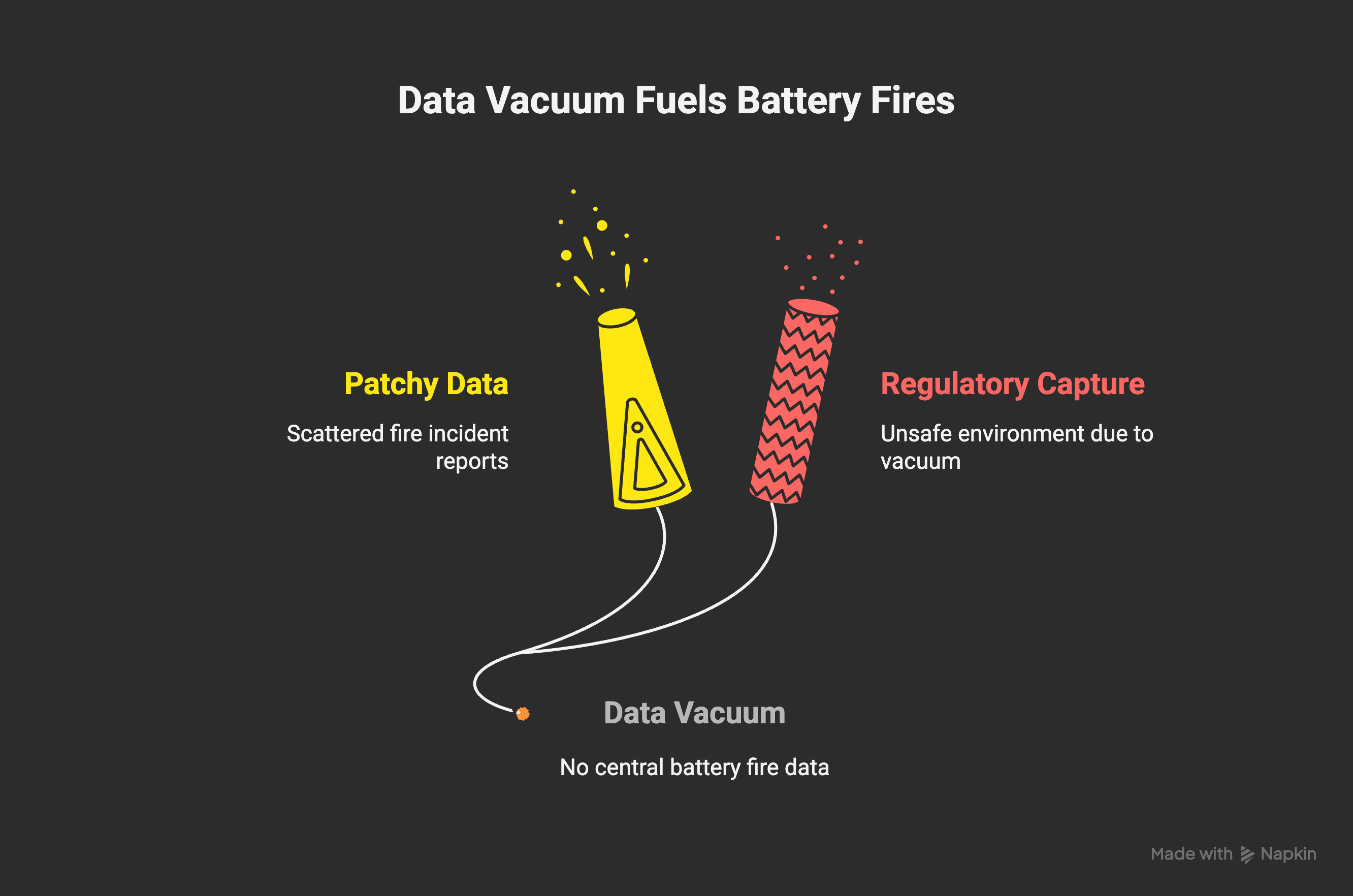
What there is not, is a UK-wide, transparent, structured database held by DESNZ or by any single national body linking battery products, installation standards and incident outcomes.
This is a data vacuum. And a vacuum - with regulatory capture - is not safe.
The suspension of battery installs was not triggered by hundreds of fires.
It was triggered by the lack of a certifiable product standard. It was triggered by an absence of governance, not an abundance of smoke.
That distinction is important.
My Earlier Warnings And The Reason They Matter
I have written repeatedly about fragility in the UK accreditation system. These were not predictions. They were observations from experts across the sector who describe the same pattern in different languages.
This pause validates those conversations.
These were expert/installer views that I brought forward. Now they are real-world events.
Flexi-Orb And The Standard The System Ignored
This is the most revealing part. After the pause letter began circulating, Mark Nelson of Flexi-Orb shared something important.
Flexi-Orb already has a product policy for domestic solar and battery systems.
It exists. It has been through working groups. It aligns with international standards. It covers product assurance and safety.
It is reviewed and updated.
If DESNZ had permitted more than one certification body to operate inside scheme rules, the current suspension would not have happened. There would have been a second pathway for product approvals. The system would have had redundancy.
Mark put it plainly:
"Had Flexi-Orb been allowed access to the funding pathways, the critical single point of failure now evident would have been avoided."
This is not an attack.
It is a factual observation from someone who works inside product safety frameworks every day.
It is also evidence that the government rejected or sidelined existing solutions that could have prevented the problem.
The Political Timing And The BUS Consultation
A sitting MP requested a briefing from Flexi-Orb on the BUS consultation.
That briefing has been provided. And now, at the very moment government is re-evaluating the structure of scheme eligibility, we have a real-time demonstration of the weakness of a single-route certification model.
This is what MPs will see:
• One certification body controls scheme access.
• That body has no battery product standard.
• DESNZ has no alternative route.
• Industry has a ready-to-use policy outside the monopoly.
• The system collapses into a pause at the first stress event.
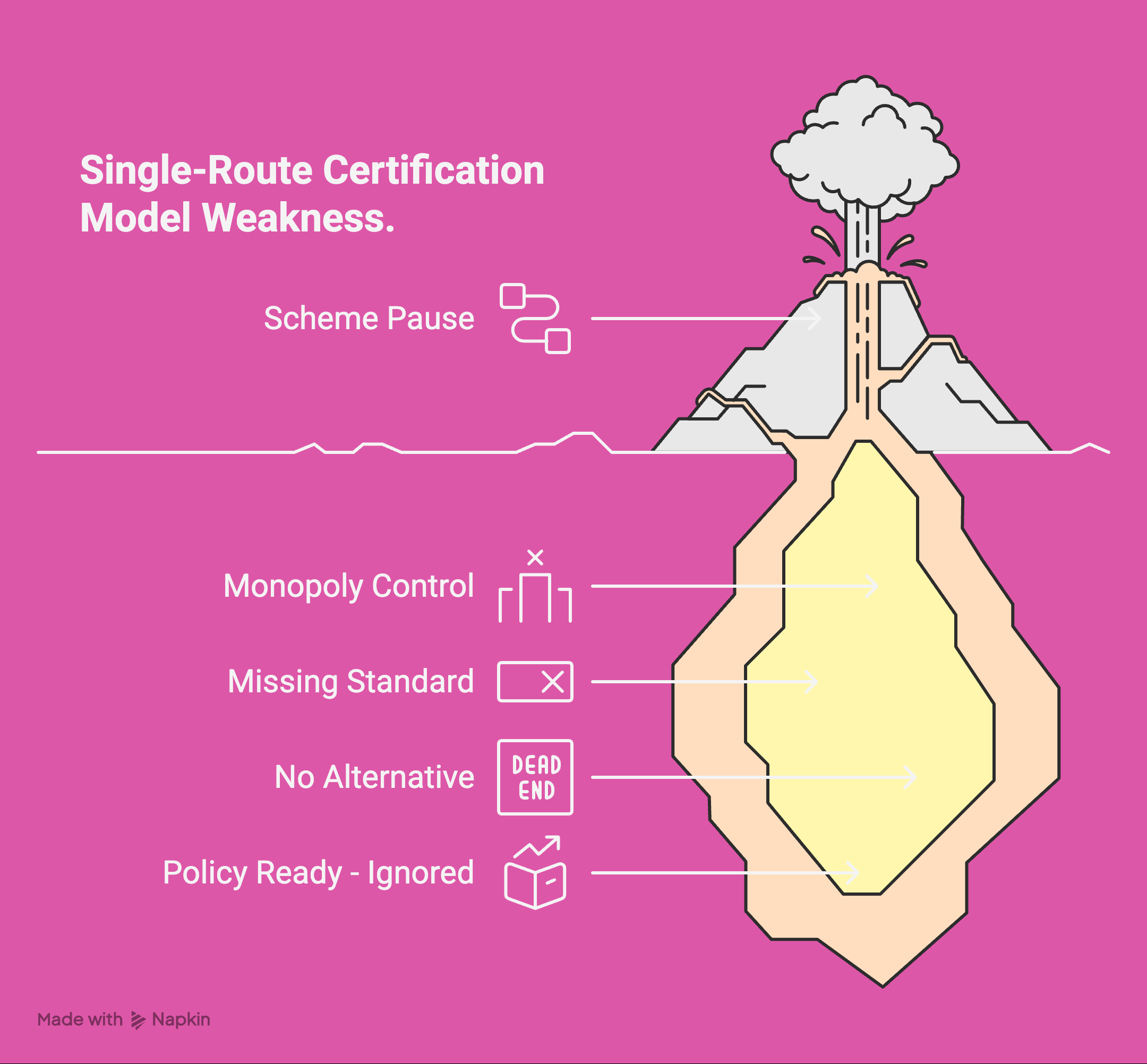
This is the kind of structural inconsistency that becomes political.
The Nature Of The Failure
Let us be very clear. The failure was not in the batteries. The failure was in the architecture of scheme oversight.
The UK built a retrofit accreditation system with:
• one gatekeeper
• one pathway
• one point of access
• no redundancy
• no backup
• no competition
• no resilience
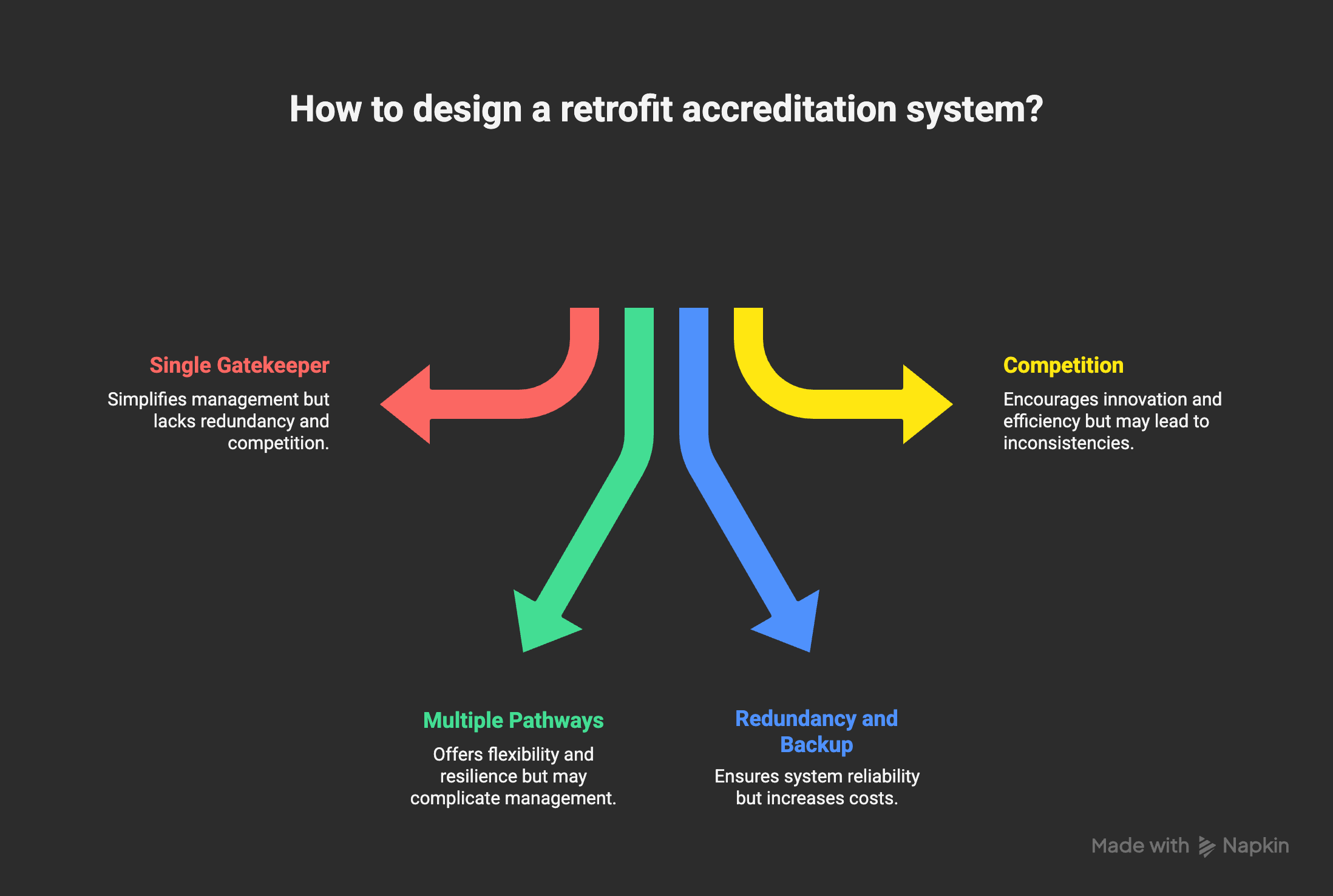
That is a formula for predictable disruption.
When innovation moves faster than standard-setting, the monopoly cannot keep pace. And when the monopoly cannot keep pace, the entire system grinds to a halt because no other bodies are allowed to pick up the slack.
Retrofit is far too important to be built on a structure this fragile.
The Impact On Installers And Homeowners
Installers now face broken workflows, time on wasted site visits, stock sitting idle, a whole bunch of customers confused - schemes in flux - and worse of all, disruption created not by technology, but by governance
Homeowners do not understand why they cannot install a product that was legal, safe and available for months, simply because a single certification body had no product standard behind the scenes.
This erodes confidence. It erodes trust. It slows national progress.
It creates an unnecessary perception that the technology is risky when the real risk is the pathway.
The Next Failure Will Be Worse
Experts tell me the same thing across multiple technologies.
This issue could have appeared in: heat pump standards, thermal stores, controls, solar, ventilation, smart-home integration, hydrogen-ready systems or hybrid heating solutions
The system is vulnerable anywhere that innovation moves faster than the monopoly can write a standard.
It will happen again unless the architecture is fixed.
The Path Out Of This
The answer is not another working group. It is not another temporary authorisation. It is not a slower pace of innovation.
It is structural.
The UK needs a multi-route accreditation ecosystem.
• Flexi-Orb should be inside scheme eligibility.
• UKAS should be empowered to oversee multiple participants.
• Competition should exist.
• Redundancy should be designed into the system.
• DESNZ should not be dependent on one body for entire technology classes.
This is how resilient systems are built.
Batteries On Fire? No. The System Is.
The title of this piece is not sensational. It captures the reality revealed by the DESNZ pause.
The fire is in the governance model. The solution existed. The solution was ignored. And the industry is now paying the price for a single point of failure that should never have been allowed to exist.
If the UK wants to deliver a national retrofit programme at scale, it cannot be built on a monopoly certification structure that collapses when one missing document appears at the wrong time.
The evidence is clear.
The moment is now.
The choices are unavoidable.
Editor’s Note
Let’s call it what it is. Parts of this sector have turned into a circle-jerk of the same voices congratulating each other while ignoring the cracks forming under their feet. That might work for PR. It does nothing for the truth.
This magazine exists to break that spell. To ask the questions that never get asked in the cosy roundtables. To challenge the narratives that keep getting recycled until they sound like facts. To expose the problems everyone else whispers about but never writes down.
If you want an independent voice that refuses to play along with the industry’s echo chambers, then back it. Subscribe. Share it. Help keep this thing standing. Because the alternative is letting the same circle-jerks decide what counts as “the truth.” And we all know how that ends.
We like to work on a chunk of facts, so if you need the same dose of reality here's some insight into our sources for this article, do yourself a favour and go find the truth you need.