
What Jet Fighters and Divorce Teach Us About Retrofit: Renovation Decisions
Fighter jets and divorce, have a lot in common with retrofit. Really?
Muscles, Jets and Decision Making
When Top Gun came out in 1986, it created a tidal wave of interest in the US Navy. Tom Cruise astride the cockpit, naked volley ball. Carcinogenic aviation fuel being inhaled by the truck load. Recruiting figures went up, probably not by the 500% attributed in some mags, but it definitely had an impact. The cultural hangover was less glamorous. A macho feedback loop that later spilled into scandals the Navy would rather forget.
Much less glamorous by product was fanzine debating whether the tactics in the film actually worked. And it was when I discovered as a socially awkward tweenager, with poor social skills, the OODA loop. I was in a British Military school. A school I had been inspired to go to - by among other things, an even younger Tom Cruise in this film.
Tom Cruise Breaks Ranks And Takes Over A School
This time not in a jet, but breaking ranks and taking over a school. I was hooked.
In Top Gun, Maverick wins dogfights not because his jet is better, but because he thinks faster.
Observe.
Orient.
Decide.
Act.
Developed during Vietnam in aerial combat between US F-4 Phantoms and Soviet MiGs, the OODA loop describes how victory goes to whoever cycles through decisions faster than their opponent.
Since then, it’s been absorbed by business schools, management consultants, and leadership gurus. Strip away the jargon and it’s simple.
Whoever understands the situation sooner, frames it better, and acts with confidence usually wins.
 Helen Wale
Why Retrofit keeps getting this wrong
Retrofit has discovered the OODA loop. But it’s using it badly.
The assumption goes like this:
Educate homeowners.
Explain retrofit.
Present the options.
Help them decide.
The problem is that homeowners are not in a retrofit decision loop.
Recent search data, including from Uswitch, shows this clearly. People do not wake up thinking about retrofit. They are not searching for PAS 2035. They are not comparing ventilation strategies.
They are doing something else.
They are renovating.
Kitchens. Bathrooms. Extensions. Redecoration. Repairs. Maintenance. The RMI sector is where the real decisions are already happening.
Retrofit companies trying to start a fresh decision cycle from scratch are burning energy they don’t have. The smarter move is interception.
Not persuasion from zero.
Interdiction mid-flow.
This is exactly what firms like Furbnow are reporting from the front line. Retrofit demand appears when it attaches itself to something else that already matters to the homeowner.
This is a tactic which needs to be adopted in retrofit to interdict the decision making cycles of homeowners.
Renovation is the opening, not the endgame
If you want to use the OODA loop properly in retrofit, you don’t start at Observe. You start by noticing what people are already doing.
They are choosing finishes.
They are managing disruption.
They are spending emotionally, not technically.
Retrofit succeeds when it slips into that process without demanding total ideological conversion.
Which brings us to the uncomfortable part.
Why retrofit should be treated like a divorce
Anyone who has dated seriously in midlife will recognise this pattern. People are at different stages of their divorce.
Not from a partner. From an old way of living. Homes are the same.
Most households are not ready for a clean break from gas boilers, legacy fabric, and familiar systems. Pretending otherwise is how projects fail.
Up to now, things have been ticking along. Not brilliantly. But not catastrophically either. And now someone is proposing radical change.
Most retrofits that fail do so for the same reasons divorces do.
Poor communication.
Too many advisers.
A rush to win instead of stabilise.
Protect the children
In a bad divorce, the children suffer when adults pursue ideology over stability. In retrofit, the children are: Thermal comfort, Air quality, Noise, Usability, Day-to-day routines
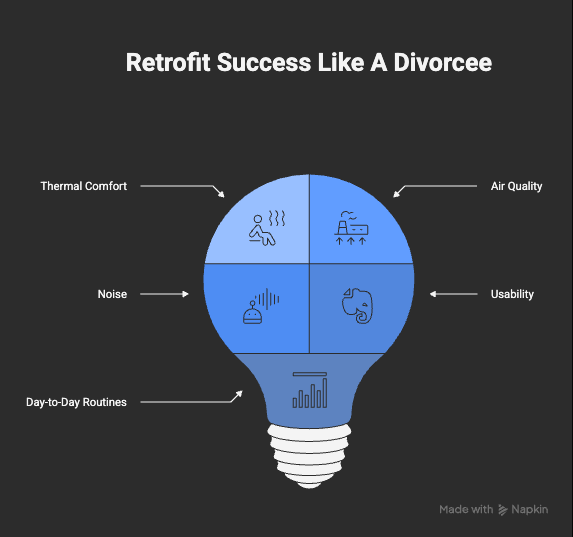
If the house becomes too cold during works, too complex afterwards, or too fragile for real life, the retrofit has failed. Carbon maths does not rescue lived misery.
This is where retrofit professionals often misjudge the emotional reality of change.
Getting inside the decision-making loop is not the finish line. It is the start of a longer negotiation. One that requires empathy, pacing, and honesty about what can and cannot be resolved quickly.
What success actually looks like
A good divorce is not one where one side wins.
A good retrofit is not one that hits a perfect spec sheet.
Success looks quieter than that.
The house works in winter.
Bills are predictable.
Systems are understood.
The occupants trust the building again.
That is how you separate from the past without destroying the future.
National Self Build and Renovation Centre - The Cockpit
This is why renovation moments matter.
In Top Gun, the dogfight isn’t won in the jet. It’s won in the split second before the turn, when a pilot realises what’s actually happening and commits. Renovation works the same way. Most people don’t need another brochure, another acronym, another argument. They need a place where they can observe properly, orient themselves without pressure, make sense of trade-offs, and then decide.

That’s what events like the NSBRC Renovation Open Day are for. Not to sell you a finished answer, but to slow the decision loop down enough that you don’t get out-manoeuvred by noise, novelty, or bad advice. If renovation is the moment retrofit sneaks into the cockpit, this is the briefing room. The point where you stop reacting, line up the runway, and choose a path you can actually live with.
No afterburners. No heroics. Just a better turn.
This weeks stories about renovations are being sponsored by Halcyan Water. Find out more about their solutions as we release case studies of their fight against hard water and limescale each day for the rest of the week.