
VIDEO CASE STUDY: A Warm Church is a Working Church
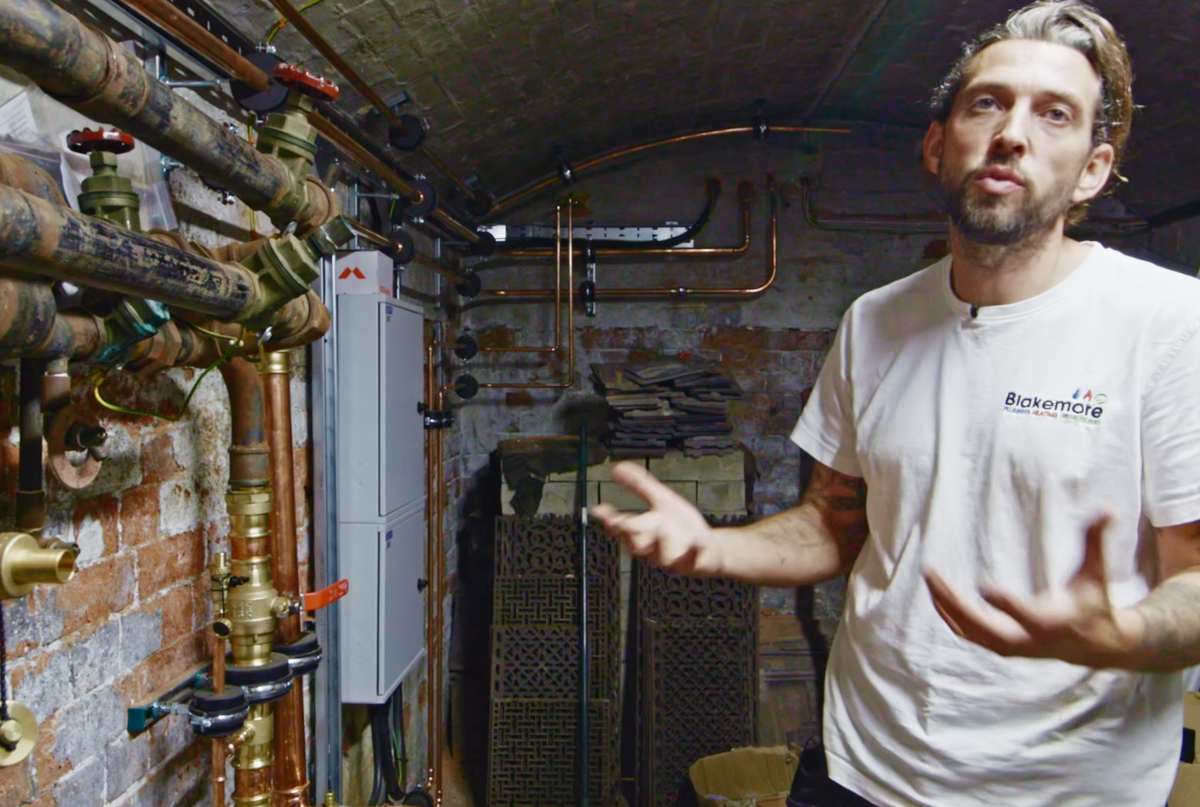
How a determined volunteer, a heating designer and Damon Blakemore's engineering team set about transforming a historic church in Bedworth.
In this church, there is a certain gravity. It centres on the parts of the building which provide the only comfort from the cold stone walls, biting outside winds and driving rain.
Anyone who's shivered their way through a harvest festival, sneezed through carols or sworn at themselves for wearing a summer dress to that nippy spring wedding - knows the feeling.
In All Saints Church in Bedworth it's the ancient cast pipes underneath the trench covers in the aisles, and if the gas heating has been set high enough, the bare pipes passing along the far outer walls. In the cold months, visitors hover like chattering birds, bustling for access to the warm wafts from the creaking pipes.
In a building like this, constantly in use, the church is a refuge, a sanctuary and a place of hope. And it should be a place of physical comfort as well. But as volunteer Christine Rigden acknowledges, it has been wanting.
“We'd have the heating on but we still wouldn't be warm - so you're paying for heating and not getting warm.” - Christine Rigden
A Church That Does Rather More Than Sundays
All Saints is not one of those churches that opens its doors for a couple of hours on Sunday, then sits empty and silent until the following weekend.
It is a busy, working building at the centre of its community.
On Thursdays, there are community lunches, making use of surplus food from supermarkets. On Fridays, grant funding supports a coffee morning where food and drinks are free. There are meetings, services, school visits, offices and a seemingly endless succession of people coming and going.
In 2000, the church underwent a substantial reordering, incorporating what amounts to a parish centre within the original building. Kitchens, offices, meeting rooms and other facilities occupy part of the footprint.
This has created an interesting problem.
The people sitting at computers in the offices need a very different environment from those attending a Sunday service, or a group of children charging around the larger spaces.
“The heating system planning has been very complicated because, as you can imagine, offices and meeting rooms are used in a very different way from a large worship space,” - Christine Rigden
And then there is the building itself.
An enormous volume of air, old stonework, historic radiators and an ageing distribution system. The sort of place where turning up the thermostat doesn't necessarily make anyone feel warmer, but certainly makes the gas meter work harder.
The temptation might be to regard this as simply the price of occupying a historic building.
Christine didn't.
The Woman with a Plan
Christine Rigden is the volunteer Sustainability Lead at All Saints. She has spent nearly two years investigating how the church could move away from fossil-fuel heating without bankrupting itself or making an already uncomfortable building even colder.
It has been an extraordinary exercise in persistence.
There have been visits to other churches, discussions with consultants and installers, research into different technologies, funding applications, permissions and a considerable amount of time spent examining energy bills and temperature records.
Christine had accumulated five years of gas-consumption and temperature data.
Rather than starting with the question of which heat pump to buy, she began by examining how the church was being heated.
That distinction would prove important.
Because there was another assumption worth challenging: that the cheapest way to heat a church is to leave it cold until someone needs to use it.
The Experiment
Traditionally, the Church had been heated intermittently.
The temperature would fall between services, sometimes to 12°C or 14°C, before the boilers were asked to drag the building back towards something resembling comfort.
Anyone familiar with old masonry buildings will recognise the problem.
The air might warm relatively quickly, but the enormous mass of stone surrounding it takes considerably longer.
And cold stone is not a particularly welcoming companion.
Christine wondered whether maintaining a consistent background temperature might change the experience.
So, between October 2025 and March 2026, the church conducted an experiment using its existing gas heating.
Instead of repeatedly allowing the Church to cool, it maintained a background temperature of approximately 16°C, increasing it to 18°C for services.
The heating ran continuously.
At first glance, this sounds like an excellent way to spend more money.
But Christine's analysis suggested that, after accounting for differences in weather, gas consumption was only around 2% higher than the comparison baseline.
Meanwhile, the experience of occupying the church changed dramatically.
The Rector, Dave, described the difference in a written account as “a revelation”.
Rooms previously uncomfortable outside scheduled services became more usable. The stonework was no longer allowed to cool so substantially between activities.
And the church began to discover that comfort is not quite the same thing as air temperature. Christine told us;
“By being warm I don't mean like your lounge, I mean like a church that's comfortable,”
The objective was never to turn All Saints into a centrally heated suburban sitting room.
It was to make the building somewhere people could occupy without spending their time wondering when they might next be able to feel their fingers.
“The great thing about being warm in this space is that it attracts more use.”
For a church whose purpose extends well beyond worship, that is a great rsult.
There is an important qualification here. This experiment took place before the new heat pumps were installed. The comfort improvements were achieved with the existing gas system, by changing the way it was operated.
But the results gave the project something invaluable: evidence that a different heating strategy could work.
The Physics of Feeling Warm
Jean Fourie, the heating designer brought into the project, explains why this is a key part of planning.
“What we found on this project is there's an incredible amount of thermal mass in the building.” - Jean Fourie
Stone absorbs and stores heat.
It can also remain stubbornly cold long after the air around it has warmed.
That is relevant because our experience of comfort depends partly on the temperature of the surfaces surrounding us.
A person sitting in a room with warm air and cold walls may feel considerably less comfortable than someone in a room at the same air temperature with warmer surrounding surfaces.
The effect is particularly noticeable in buildings with large areas of exposed masonry.
But thermal mass can also work in the occupants' favour.
“If you get it up to temperature then it actually acts as an amazing buffer to the space so you don't get these big swings in temperature,” - Jean Fourie
It does not eliminate heat loss. Nor does it magically turn stone into insulation.
What it can do is moderate changes in internal temperature when the heating is operated consistently.
And this creates an opportunity for heat pumps.
Rather than relying on bursts of high-temperature heat, a properly designed heat-pump system can maintain a more consistent internal environment, provided the emitters and distribution system can deliver enough heat at suitable water temperatures.
The question was whether that could be achieved at All Saints without tearing the building apart.
Choosing the Right Technology
The church's investigation was not confined to air-source heat pumps.
Working with engineering consultancy Max Fordham, supported by a Net Zero Demonstrator Church feasibility-study grant, Christine and the team examined several alternatives.
Ground-source heating was considered, but the estimated cost was £250,000 or more, including associated works. Excavation and disruption around the High Street also presented difficulties.
Underfloor heating offered possibilities, but raised questions about the existing floor construction, disruption, acoustic treatment and the cost of the work.
Infrared heating was assessed, but was not considered the best solution for a building with so many different spaces and patterns of use.
Air-to-air heat pumps presented their own challenges. The church anticipated needing at least six external units, bringing concerns about positioning, appearance, noise and the distribution of heat.
Air-to-water heat pumps offered another possibility.
They could make use of much of the existing heating distribution, preserve the historic cast-iron radiators where appropriate and introduce additional emitters where the existing system could not provide enough heat.
It was not necessarily the simplest solution.
But it offered a way to balance performance, cost, disruption and the character of the building.
Christine was particularly conscious of the financial constraints.
“And it's an impoverished area. We don't have that kind of money. It's all coming from grants as it is.”
The church needed a solution it could realistically deliver.
And that meant getting the engineering right.
Enter Damon Blakemore
By the time Damon Blakemore and his team arrived at All Saints, a great deal of work had already taken place.
Christine had assembled the evidence and helped drive the project forward. Jean had developed the heating design.
Now someone had to make it work.
And historic buildings are not always particularly cooperative when confronted with the intentions of heating engineers.
The existing distribution system was old. Access was restricted. Pipework disappeared into places that were difficult to inspect, and replacing everything would have created considerable expense and disruption.
Damon's approach was to preserve what could still do a useful job.
“You've got to be sympathetic to it. You've got to respect it. You've got to respect your surroundings. It's not all about just getting in what's new.” - Damon Blakemore
This is a rather important point in retrofit.
The objective is not necessarily to remove everything old and replace it with something shiny.
It is to understand what already exists, establish whether it remains fit for purpose and introduce new technology without creating unnecessary work.
At All Saints, the retained open-vented heating network was separated from the new pressurised heat-pump circuit using a plate heat exchanger.
This allowed the heat pumps to operate within their own hydraulic arrangement while preserving much of the building's existing distribution infrastructure.
The old cast-iron radiators could remain, supplemented by new fan-assisted emitters where additional output was needed.
In principle, straightforward.
In practice, rather less so.
Trouble in the Trenches
One of the most interesting engineering challenges lay beneath the floor.
The existing heating trench had long been a source of warmth for people gathering in the Sanctuary.
It was also an obvious place to introduce additional heat without filling the historic interior with large new radiators.
Jean was determined to improve heat distribution towards the centre of the room.
“We really really wanted a way to bring some more heat into the middle of the room.”
The solution involved fitting fan-assisted heating emitters into the trench.
These use fans to move air across a heat exchanger, increasing the amount of heat transferred into the room.
They can provide substantial output without requiring the same large exposed radiator surfaces, making them useful in buildings where appearance and available space matter.
But getting them into an existing trench was not as simple as drawing a rectangle on a plan.
There were uncertainties about the connections, the available space and how the new equipment could be accommodated.
At one point, an alternative using freestanding fan convectors was considered.
Damon wasn't keen to abandon the trench solution.
“But I didn't want us to be beat so I just said we're doing it.”
It is a wonderfully uncomplicated response to a rather complicated engineering problem.
And it illustrates something frequently overlooked in discussions about retrofit.
Good design is essential, but so is the ability of an installation team to solve problems when the reality of an existing building refuses to match the drawings.
The success of projects like this depends on both.
A Little Respect for History
There was another constraint.
All Saints needed to remain recognisably All Saints.
Nobody wanted a historic church transformed into an exhibition of exposed plastic trunking, oversized equipment and poorly positioned pipework.
The location of the heat pumps, the routes taken by services, the positioning of emitters and the appearance of the finished installation all required consideration.
For Jean, the ambition was straightforward.
“Our job is actually to make sure no one really notices what's going on so they don't feel cold they don't feel hot they just feel comfortable.”
Damon shared that view.
“You could easily make it look an eyesore, so we're trying to be more sympathetic towards what the building is.”
The project required formal permissions, including Diocesan Faculty approval, reported as granted in April 2026, and planning permission in June.
The supporting work included a noise assessment, heritage information and visual mock-ups.
These requirements are sometimes presented as obstacles to decarbonisation.
But they are also part of the responsibility that comes with altering buildings of historical importance.
The challenge is to accommodate modern technology without unnecessarily sacrificing the character of the place.
At All Saints, the design and installation teams have attempted to do precisely that.
The Refurb & Retrofit film follows Damon Blakemore and his team as they adapt the existing heating infrastructure, install new emitters and commission the renewable heating system at All Saints.
Two Heat Pumps, One Complicated Building
The finished design uses two heat pumps to serve different parts of the church.
That separation reflects the very different requirements of the Sanctuary and Parish Centre.
The Sanctuary is intended to maintain a background temperature around 16°C, with increases for services and other activities.
The offices have a higher intended background temperature, around 18°C, while circulation areas can operate at lower temperatures.
This avoids treating every room as though it has the same purpose.
It also allows the building's heating to respond more closely to how people use it.
There are still difficult spaces.
One office, known as the Studio, adjoins an unheated cellar and a turret, creating particular comfort challenges.
The design documentation identifies measures including secondary glazing, ceiling insulation and a larger convector to improve conditions.
It is another reminder that buildings are rarely uniform.
Even within a single property, different rooms can require different interventions.
“You could have a church next door and it would be a totally different system so it's critical to get the needs of the people and the building,” Damon explains.
This is why the idea of a standard solution for every church, school, hall or historic building is so problematic.
The principles may be transferable.
The specification rarely is.
The Importance of What Happens Afterwards
For Damon, getting the equipment installed is only part of the job.
The system must also be maintainable.
Water quality, filtration, flushing arrangements and access to components all matter if the investment is to deliver reliable performance over the coming years.
“Just keeping it clean, you know, it's a lot of money that they're spending. They want it to perform well. They want it to be able for it to last.”
The hydraulic design was also examined with an eye to avoiding unnecessary complexity and additional pumping energy.
This matters because the efficiency of a heat-pump installation is not determined solely by the performance of the heat pump itself.
Circulation pumps, controls, operating temperatures and the way heat is distributed throughout the building all contribute to the overall result.
Damon has therefore incorporated OpenEnergyMonitor equipment to record performance.
“We've got the open energy monitor which will record how well it's doing so there's nowhere to hide.”
Quite right.
The retrofit industry has spent far too long arguing about what equipment should achieve, rather than consistently demonstrating what installed systems actually deliver.
Monitoring makes it possible to examine performance, identify problems and improve the operation of the building.
During commissioning, Damon reported that the system was delivering heat and achieving the required flow rates, with further balancing and adjustment still to follow.
That establishes an important milestone.
But the real test is what happens over the first full heating season.
The Numbers Behind the Ambition
Christine's financial analysis provides a useful insight into why the project was considered viable.
The church's historical managed gas consumption was approximately 70,000 kWh annually.
At the gas price used in her calculations, 5.8p per kWh, that represents roughly £4,060 in annual unit charges.
The analysis assumes that the old boiler system was operating at around 65% efficiency.
That would mean approximately 45,500 kWh of useful heat was being delivered to the building.
If the new heat-pump system achieves a seasonal performance factor of three, providing three units of heat for each unit of electricity consumed, it would require approximately 15,000 kWh of electricity to provide a similar amount of heat.
On the electricity tariffs used in Christine's assessment, the projected cost was around £3,600 to £3,900 annually, before accounting for the contribution from solar generation.
These are estimates, not measured savings.
But they explain why a heat-pump system could potentially provide similar running costs to the old gas installation, despite the higher unit price of electricity.
Christine's expectation was that “The heat pump heating should cost roughly about the same as the gas”.
There is another part of the equation.
All Saints already has a substantial solar PV installation.
Christine reports 50 panels, with a combined capacity of around 22 kW, alongside approximately 21 kWh of battery storage.
In 2025, the solar installation generated 21,485 kWh of electricity, with approximately 58% reportedly used directly by the church.
The combination of generation, storage and export payments has already affected the building's electricity expenditure.
Christine reports that between May and November 2025, export income offset the church's electricity charges, producing no net electricity payments over that period.
That does not mean the church stopped importing electricity from the grid.
Nor does it mean solar panels will provide all the energy required for heating through the winter.
But it does demonstrate the potential value of considering generation, storage and heating as parts of a wider energy strategy.
For All Saints, the objective is not simply to replace one fuel with another.
It is to reduce dependence on fossil fuels while keeping the building affordable to operate.
Not Just a Winter Problem
There is an irony in the assumption that old stone churches are always cold.
Some can become distinctly uncomfortable in summer.
Christine's records include temperatures of 29°C in the Sanctuary and above 30°C in some offices.
The fan-assisted emitters selected for the project have the potential to provide cooling as well as heating, although whether that capability is enabled and fully commissioned at All Saints remains to be confirmed.
It raises an increasingly important question for owners of existing buildings.
How do we provide comfort throughout the year, rather than simply replacing the equipment that keeps us warm in winter?
As buildings are adapted to changing weather patterns, summer overheating deserves as much attention as winter heating.
The objective, after all, is comfort.
Not simply compliance with a heating specification.
The Proof Will Be in the Winter
There is a temptation, particularly when an installation looks impressive, to declare success as soon as the equipment starts running.
But the story at All Saints is not quite finished.
The team has demonstrated that renewable heating can be designed and installed within a historic church while retaining much of the existing heating infrastructure.
Christine's earlier experiment has shown that changing the heating strategy can substantially improve comfort without necessarily producing a comparable increase in energy consumption.
The heat pumps have been installed and brought into operation.
What remains to be established is how the system performs over a complete winter.
That means measuring electricity consumption, heat output, seasonal efficiency and comfort across the different parts of the building.
It also means examining whether the operating costs meet Christine's expectations.
For Jean, the project challenges a familiar assumption.
“These are exactly the type of buildings that people will say you can't use heat pumps on”.
He has a point.
Too often, the conversation about decarbonising older buildings begins with a list of reasons why something cannot be done.
The building is too old.
The radiators are unsuitable.
The walls are too thick.
The heating costs will be too high.
The equipment will spoil the appearance.
Sometimes those concerns are legitimate. They deserve investigation, not dismissal.
But they are not necessarily reasons to abandon the project.
They are reasons to undertake the research, commission appropriate design work and find engineers capable of delivering the result.
More Than a Heating Project
Back at All Saints, the most important measure of success may ultimately be something that never appears on a monitoring dashboard.
It is whether people feel comfortable enough to use the building.
Whether the offices are warm enough for staff.
Whether community activities can take place without people gathering around exposed pipes.
Whether the church can offer sanctuary in the most practical sense of the word.
Christine's observation deserves repeating.
“The great thing about being warm in this space is that it attracts more use.”
That is the social value of making buildings better.
It is not always captured in a simple payback calculation.
For Damon, the project also represents a direction of travel.
“Yeah, we've proved a point. This is the direction the business is going in. We're going to be doing more of these projects going forward. So it's been nice to get this one over the line.”
There will be more buildings like All Saints.
More ageing heating systems. More awkward pipework. More trustees and building managers worrying about budgets, energy prices and the prospect of getting an expensive decision wrong.
The lesson from Bedworth is not that every historic building needs precisely this arrangement of heat pumps, heat exchangers and fan convectors.
It is that the process matters.
Understand the building. Listen to the people using it. Collect evidence. Challenge assumptions. Find the right expertise. Respect what already exists. And measure what happens afterwards.
Jean offers a fitting final observation.
“We've got a beautiful church that looks just as stunning as it did before if not a bit more stunning”.
If the coming winter confirms the engineering predictions, All Saints will have demonstrated something rather more valuable than a successful equipment replacement.
It will have shown that a building built for another age can continue serving its community in this one.
And perhaps, when the next harvest festival comes around, there will be rather fewer people competing for a place above the heating trench.
Reporting and filming: Refurb & Retrofit / Retrofit.Video. The accompanying film was commercially commissioned by Blakemore Renewables.
This independent editorial feature draws on interviews with Christine Rigden, Jean Fourie and Damon Blakemore, and supporting technical documents prepared by All Saints Bedworth.