
No One Should Die. How We Stop Britain Forgetting Summer
Heat is a problem. Keeping it in homes. And keeping it out. Both can be deadly. Why do we forget?

This ritual plays out every summer. Shimmering pavements and languid hot days give way to buckling rail links, ambulances flying down roads to distressed people, cold fridges failing and supermarkets devoid of fans - as presenters stand in front of angry, crimson coloured maps.
It's unbearably, deadly hot. For a few days. Then as the temperature drops. The conversation switches, and thermometer posts or sweaty selfies in packed carriages gives way to downpours and drizzle.
Heat waves still get reported on like a summer outing. The fantastical solutions to cooling are celebrated as wacky Brits dive into the heat.
Kepis in the burning sun. Burned flesh as a token of resistance. The climate won't beat us, plucky lot. Then. As Autumn breaks. We forget the uncomfortable and head back to work, school and the grind.
This collective amnesia is costing lives.
Forgetting History
During the record-breaking summer of 2022, temperatures exceeded 40°C for the first time in UK history. Thousands of excess heat-related deaths were recorded across England and Wales. Ambulance services came under extraordinary pressure. Hospitals struggled to cope. Homes designed to retain heat during winter became ovens during prolonged periods of sunshine.
For many people, those few weeks became another remarkable chapter in Britain's changing weather.
For others, they became the reason an entirely new organisation was born.
Shade the UK is not a campaigning charity in the traditional sense. It is a community interest company trying to answer a deceptively simple question: how do we stop people dying because their homes, streets and public spaces become dangerously hot?
The organisation emerged from the work of environmental designer Andy Love, whose career modelling the thermal performance of buildings exposed an uncomfortable truth. While enormous effort had gone into understanding how new buildings complied with planning requirements and energy regulations, far less attention had been paid to how existing buildings actually behaved during increasingly frequent periods of extreme heat.
That gap became impossible to ignore after 2022.
"The reason Shade the UK was set up," explains Polly Turton, the organisation's communications lead, "was through understanding how existing buildings performed thermally and realising there was a huge gap in knowledge. The emphasis has always been about understanding how heat impacts existing buildings and spaces in our towns and cities, and then doing practical things to help them cope better with hot weather."
The heatwave transformed an interesting technical problem into a public health emergency.
One of Shade UK's earliest projects became 40 Degree Stories, a photographic exhibition documenting the lived experiences of people caught up in Britain's hottest summer. Rather than focusing on temperature records or climate projections, it placed ordinary people in front of the camera and asked what those extraordinary weeks had actually felt like.
From pensioners to teachers to paramedics. The unifying factor which linked so many of the collected stories was that those most vulnerable often had the quietest voices. They were not suited men, in city office blocks being chilled with vast AC units.
"We realised we needed a theory of change. Our goal is achieving zero deaths from overheating and creating a country where everyone can live, work and thrive in hot weather." Polly Turton - Shade The UK
It is a deceptively bold ambition. At first glance it sounds idealistic.
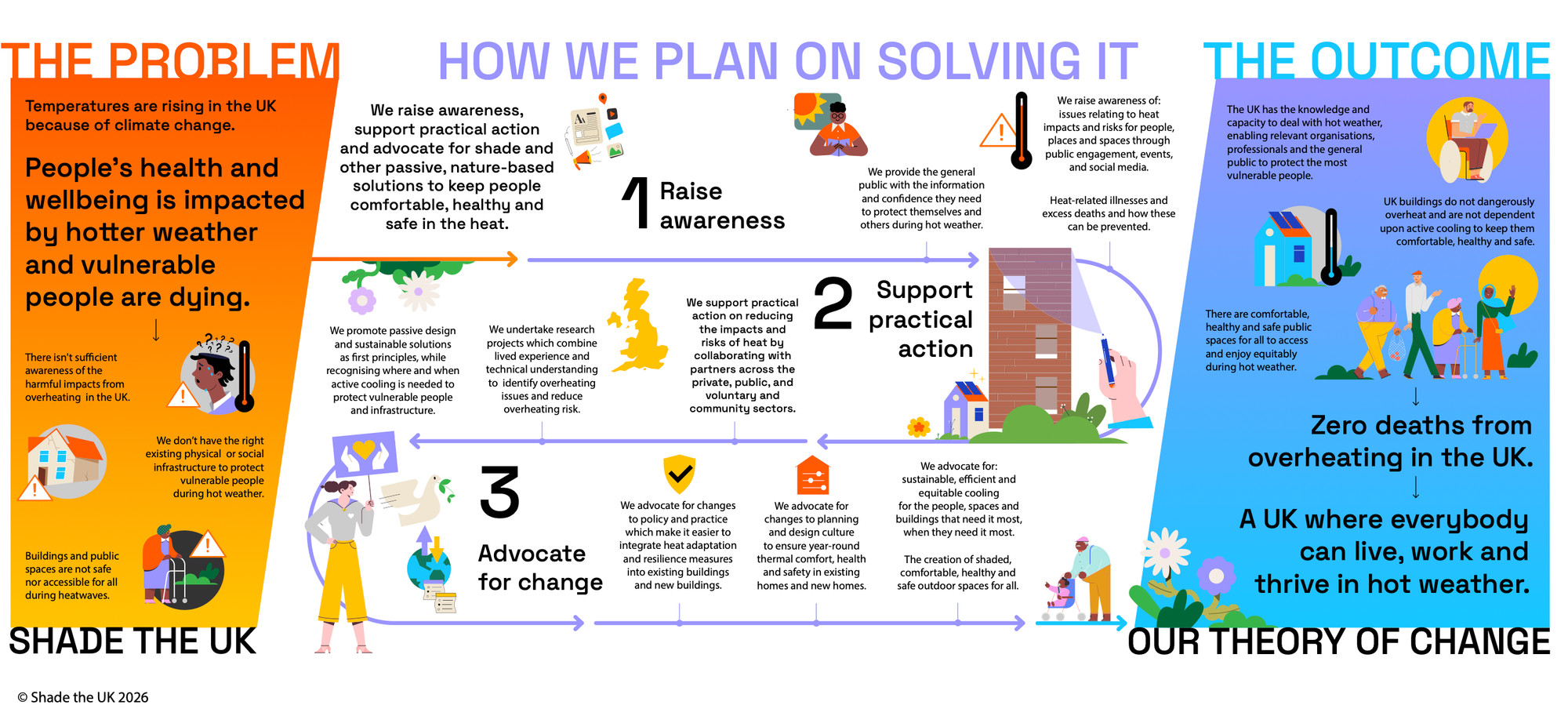
The longer you talk to the people working in this field, the more practical it begins to sound.
Unlike earthquakes, hurricanes or volcanic eruptions, overheating is rarely an unavoidable natural disaster. Most heat-related deaths occur because buildings trap heat, public spaces offer too little shelter, vulnerable people are isolated, or simple interventions were never put in place.
Heat, in other words, exposes weaknesses that already exist.
Those weaknesses are rarely distributed equally.
Older people struggle to regulate body temperature as effectively as younger adults. Babies and young children are particularly vulnerable. People living with chronic illness, respiratory disease or cardiovascular conditions face greater risks. Add poverty, poor housing, disability or social isolation, and vulnerability compounds rapidly.
These are not niche groups.
They represent millions of people living in Britain's housing stock.
This is where the conversation with Polly hit a stumbling block. There's so many myths I said about buildings. Polly didn't hold back.
Myth 1: Air conditioning is banned in Britain
This is the first myth Polly nailed - almost immediately.
"One of the biggest myths that is being perpetuated is the myth of air conditioning being banned in the UK... Air conditioning is certainly not banned in this country."
Uptake has historically been low because Britain simply hasn't experienced sustained periods of heat and humidity, not because of regulation.
Myth 2: Air conditioning is always bad
This is more nuanced than many campaigners admit.
"Another myth is that air conditioning is bad and passive and nature-based is good. Sometimes you need active cooling."
Her argument isn't anti-air conditioning.
It's anti-using air conditioning as the first rather than the last intervention.
Myth 3: Cooling starts with technology
"The cooling hierarchy... starts with minimising unwanted solar gains coming into a building... Then there's the management of air... Only then, at the bottom of this cooling hierarchy, have you got air conditioning."
It's a stepping stone process.
"Any active cooling... works more efficiently and more effectively and is a lot cheaper to run if you've done all those other things first."
Myth 4: Overheating is just uncomfortable
For someone in an office block, the interstitial moments between air conditioned train carriages and AC controlled offices, is a pain. But for people in over heating schools, homes and hospitals it's deadly.
"We think any death caused by hot weather in this country is an avoidable death."
But let's be honest. It's hot here but not the Sahel. So why?
"We're not the hottest country in the world. We're one of the least prepared for it."
Overheating is not an inconvenience it's a preventable mortality.
Myth 5: Insulation is only for winter
We spend a lot of time in this sector talking about fabric first...but.
"Good insulation... keeps the warmth in if it's decent, and it keeps the heat out if it's decent."
Polly has had her own loft conversion:
"That loft... starts feeling the heat from about 10 a.m. onwards... If we'd specified a better quality construction and insulation, that loft would be much more comfortable in the summer, but also warmer in the winter."
The Capital Cost of Doing Nothing
There is an uncomfortable habit that runs through Britain's infrastructure debates. Whenever someone proposes spending money on adaptation, the first question is almost always the same.
How much will it cost?
Far fewer people ask the more important question.
What is the cost of carrying on exactly as we are?
Overheating already carries a price tag. The NHS pays it. Local authorities pay it.
Ambulance services pay it. Employers pay it.
Families pay it.
The only difference is that these costs appear across dozens of budgets rather than one neat retrofit programme.
When I raise this with Polly, she doesn't reach for ideology. She points to the emergency services.
"We saw the busiest London Ambulance Service day ever. Busier than COVID. Busier than the 2022 heatwave. It was all because of hot weather."
Think about that for a moment. Britain's busiest ambulance day wasn't triggered by terrorism. Or pandemic.
Or industrial disaster.
It happened because the weather became too hot for the buildings, transport networks and public spaces we ask millions of people to occupy.
Think beyond the patient.
The paramedic working in full PPE.
The care worker climbing four flights of stairs.
The bus driver without adequate cooling driving workers.
The commuter standing on an unshaded platform - degraded, worn out.
That's the hidden cost.
"Imagine if even half of those people were able to live in slightly more comfortable homes or travel on slightly cooler buses. I imagine the impact on the ambulance service alone would save a big amount of money."
Polly is careful not to present herself as an economist.
She doesn't need to.
The economics are becoming increasingly difficult to ignore.
Recent research examining thousands of retrofitted homes has begun to show measurable reductions in demand on health services alongside improvements in wellbeing. Every avoided hospital admission, every prevented episode of heat stress and every resident able to remain safely in their own home carries a financial value long before it becomes a political argument.
Britain Already Knows How To Build A Cooler Future
The easiest mistake to make after talking about overheating is to assume the story ends with rising temperatures and mounting death tolls.
It doesn't.
Spend an hour with Polly Turton and another narrative emerges. One that is less about catastrophe than capability.
Britain is not short of ideas. It is short of urgency.
"I am a realistic optimist," she tells me. "Because if you don't have a bit of realism, you're a bit of a delusionist, aren't you?"
Then she smiles.
"I don't think it is beyond the realms of human ingenuity to get ourselves out of the problem we've got ourselves into."
That optimism isn't blind faith in technology. Nor is it nostalgia for a greener past.
It is confidence that the solutions already exist.
Some have stood beside our streets for hundreds of years. I quick fire Polly with examples of solutions;
Trees.
Shade.
Better ventilation.
Lighter roofs.
External shutters.
Thoughtful urban design.
Passive cooling.
Others are emerging from British laboratories.
During our conversation I mention a company that few people outside the cooling industry have yet encountered: Barocal, the Cambridge-based climate technology company developing a radically different approach to refrigeration and cooling.
Rather than relying on conventional refrigerant gases, Barocal's system exploits the barocaloric effect, where specially engineered solid materials heat and cool simply by applying and releasing pressure. If successfully commercialised, it promises efficient cooling without many of the environmental compromises associated with traditional systems.
Turton hadn't yet explored the technology in detail.
Her response was immediate.
‘This is super, super interesting…’
It becomes one of the more revealing moments in the interview.
Because the future Polly describes is not one built on choosing between technology and nature.
It is built on combining both.
Earlier in our conversation I ask her a deliberately unfair question.
Trees or technology?
She doesn't hesitate.
"Trees."
Moments later she is enthusiastically discussing emerging cooling technologies.
There is no contradiction.
Nature buys us time.
Engineering expands our options.
Good design reduces demand.
Innovation solves the problems that remain.
Perhaps that is the lesson retrofit now needs to learn.
For years the sector has framed climate adaptation as a series of difficult compromises.
Shade the UK argues the opposite.
The most resilient buildings of the future may simply be the ones that remember how people actually live through summer.
You can support Polly and her team with their excellent work. The are raising £25,000 for their CIC to help build the UK's heat resilience movement. Your support will enable Shade the UK to train volunteers and protect vulnerable people.