
Homely: Rewiring the Heat Pump Market

Why a Manchester control platform may become one of the most important assets in Europe’s electrified heating future.
There are now more than 55 heat pump brands competing in the UK market, a level of competition that would have seemed implausible just a few years ago.
At the same time, the industry is confronting an difficult times.
Installing a heat pump is not the same as installing a boiler.
The hardware works. The physics works. The challenge is increasingly software, commissioning, and operational intelligence, the invisible layer that determines whether a system runs cheaply, quietly and reliably for the next twenty years.
This is the gap companies like Homely are attempting to fill.
What began as an academic exploration into energy optimisation has evolved into a technology platform now controlling thousands of heat pumps across the UK and expanding into Europe. And if the company succeeds, it may become one of the most important control layers in the electrification of heating.
From PhD Thesis to Heat Pump Control Platform
Homely’s origin story is not marketing mythology. It began in academia.
The concept emerged from research at Manchester University, where the company’s original founder was studying the economic optimisation of energy demand and storage. The founders story is well worn right of passage the team at Homely know well.
Jamie Elliot, the current MD of Homely, explains:
“It really came from an interest in trying to understand the economic optimisation of energy use and storage and how you can shift demand around power networks.”
The key insight came quickly.
Electric heating was about to become one of the most important flexible loads on the grid.
“When he [Dr. Karolis Petruskevicius Founder of Homely] looked at shifting demand around, it became really interesting with heat and particularly the growth of heat pumps.”
Heat pumps were already dominant across Scandinavia and Eastern Europe. But the UK, with its gas dependency, was lagging behind.
The research question became clear.
Could a technology platform optimise heat pump operation in real time, responding to weather, electricity prices, and grid demand?
That academic question eventually became a company.
“In 2018 it spun out as a side project called Homely… to test whether there was an opportunity to build scalable technology that could optimise heat pumps and shift demand around.”
Two years later the business was acquired by Evergreen Earth, a Manchester-based social impact investment group focused on sustainability technologies.
Today Homely has moved far beyond its research origins.
“We now have a full product team, hardware engineers, software engineers, service, sales, modelling, everything in-house.”
The company designs its hardware internally and manufactures locally near Manchester.
And crucially, the technology is now operating in real homes.
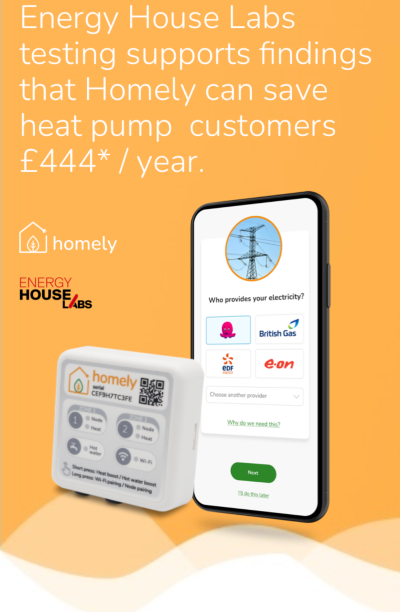
The Real Problem: Heat Pumps Are Software Systems
Across the retrofit industry, one problem is repeatedly raised by installers.
Commissioning.
Setting up weather compensation curves, flow temperatures, modulation behaviour and system optimisation is complex, and mistakes generate call-backs.
Homely’s proposition is simple.
Remove as much manual commissioning as possible.
“Setting up weather compensation curves is one of the biggest reasons installers get call-backs after installation.”
Instead of installers manually configuring systems, Homely uses dynamic modelling.
“Homely removes that altogether. We do that through our dynamic programming.”
The platform creates a digital thermal model of each home.
“Every home we individually build a digital footprint of its heat loss and gains.”
This model allows the system to predict heating behaviour hours in advance.
“We understand how quickly it heats up, how quickly it loses heat, solar gains, and weather forecasts.”
The result is predictive heating.
Rather than reacting to temperature changes, the system anticipates them.
Daniel Murphy Explains How He Uses Homely
Why Homely Is Brand-Agnostic
One of Homely’s most important strategic decisions was remaining heat-pump brand agnostic.
This is not accidental.
Installers rarely work with a single manufacturer.
“Most installers offer two or three brands… what they told us is every heat pump has different levels of insight, different interfaces and different logins.”
Homely solves this fragmentation with a single platform.
“We provide one portal where installers can look at all the heat pumps, regardless of brand.”
Technically, the system connects directly to heat pumps through Modbus communication.
“We connect via the Modbus terminals inside the heat pump… which gives us very deep control of the system.”
But achieving this compatibility requires significant work.
“Every brand has different Modbus registers… we have to investigate every model and test the integrations intensively.”
This invisible engineering effort is one reason Homely’s role is becoming strategically important.
It is effectively building a universal operating layer for heat pumps.
Understand Homely
The Installer Problem: Commissioning at Scale
The UK heat pump market currently contains two distinct installer cultures.
Small installers.
And scaled installation businesses installing hundreds or thousands of systems per year.
Josh Hart, Product Manager at Homely - describes the difference.
“Some installers commission systems almost like performing magic… whereas larger installers develop bundles and commission them the same way every time.”
Large installation companies often automate commissioning entirely.
“They’ll arrive with a USB stick, plug it in, and commission the system in minutes.”
Homely’s commissioning tools aim to bring this system-based approach to smaller installers.
The platform asks installers key questions about the system and property.
Based on those inputs it configures heat pump parameters automatically.
“We ask questions about flow temperatures and system limits and then we commission the heat pump so we can control it.”
This dramatically reduces setup complexity.
But the real advantage comes after installation.
The ConnectPro Platform: Managing Heat Pumps at Scale
Homely’s installer platform ConnectPro turns heat pump portfolios into remotely managed assets.
Installers can monitor systems, adjust parameters, and diagnose faults without visiting the property. Josh told us;
“They can push remote parameter changes or adjust flow rates remotely, avoiding going to site.”
For installers managing hundreds of systems, this becomes essential.
“Put yourself in the situation where you’ve installed 1,000 heat pumps… how do you support those customers without tools to see what’s happening?”
The system surfaces operational data, fault codes, and performance metrics in real time.
This capability could reshape the economics of the industry.
Remote diagnostics dramatically reduce call-outs and service costs.
Heat Pumps as Grid Infrastructure
Beyond installer tools, Homely’s technology addresses a much larger problem.
The electrical grid.
As Britain electrifies heating and transport, flexible energy demand becomes critical.
Homely’s modelling allows heat pumps to behave like distributed energy assets.
During winter trials, customers opted into demand flexibility schemes.
“We ran 11 events over winter where heat pumps were turned down for 90 minutes to reduce grid demand.”
The system pre-heated homes before the event using stored thermal energy in the building.
“We build extra heat into the home so we can turn the heat pump off temporarily without affecting comfort.”
The results were striking.
“At the end of all 11 events, 98% of customers stayed opted in.”
This suggests households are comfortable participating in grid flexibility — provided comfort is protected.
For the future electricity system, that insight is significant.
Understanding Heat Pump Customers
Homely’s platform also provides rare insight into how households actually use heat pumps.
Two customer groups dominate.
First are the tinkerers - highly engaged users adjusting settings constantly.
Second are the mass-market homeowners who simply want the system to work.
“Some people change settings every ten minutes… but most people set it up and then forget about it.”
Homely’s philosophy prioritises simplicity.
“Comfort is always first. If you say you want 20 degrees at a certain time, we make sure you’re there.”
Once comfort is secured, the system optimises for cost and efficiency.
“Underneath comfort, we try to save as much money as possible.”
This “set and forget” model may be critical for mainstream adoption.
Most households do not want to become heating engineers.
Trust, Security and System Resilience
One of the biggest concerns for homeowners adopting connected technologies is resilience.
What happens if the platform disappears?
Or the internet fails?
Homely’s architecture attempts to address this directly.
“The last set of commands is stored locally on the hub, so the heat pump continues operating even if the internet connection is lost.”
The company also follows established security frameworks and continuous monitoring.
“Security is a continuous process… we follow industry frameworks and constantly update our systems.”
In a world increasingly concerned with infrastructure security, these questions are becoming central.
Heating is no longer just a household service.
It is part of national energy resilience.
Europe, Solar and the Next Phase
Homely is already expanding beyond the UK.
The platform is now operating in Lithuania, Latvia and the Netherlands.
But the next evolution goes beyond heat pumps.
The company is developing integrations across the entire home energy system.
“We’re thinking beyond the heat pump itself, how it interacts with solar, batteries and electric vehicles.”
A solar optimisation feature is launching soon.
“A new feature launching this spring will allow Homely to optimise excess solar and turn it into heat and hot water without additional hardware.”
This shift hints at a broader ambition.
Homely is positioning itself not just as a heat pump control system — but as part of a whole-home energy management platform.
Infrastructure of Electrified Heat
After two decades reporting in specialist technical industries, one pattern repeats itself.
Every hardware revolution eventually becomes a software revolution.
Heat pumps are now entering that phase.
The physical machines are improving rapidly.
But the real battle is now being fought in commissioning tools, control systems, and energy optimisation.
Homely sits precisely at that intersection.
If heat pumps are the engines of electrified heating, platforms like Homely may become the operating systems that make them work.
And in an industry about to scale from tens of thousands of installations to millions, that layer could become one of the most valuable pieces of infrastructure in the entire retrofit economy.